
Are you ready for the world of tomorrow?

Updated: Aug 10

This is your future family, friends, and colleagues....(Source: here)
When I grew up in Denmark in the 1970s, I rarely met anyone who wasn't ethnically Danish. Literally everyone I knew was Danish - from family members and friends to shop keepers and bus drivers.
Today, everything is different. Walk down any street in any town in Denmark and you will soon bump into someone from somewhere else. The bus driver is from Turkey. The guy who cuts your hair is Syrian. Your neighbour is Polish. The greengrocer is Iraqi. Your favourite garbage collector, the guy with the big smile, is from Rwanda.
This is not just a Danish phenomenon. It is happening in all countries, rich and poor alike. As the world gets ‘smaller’, populations get more and more mixed. We are in the midst of an unprecedented coming together of global populations, which is driven by powerful structural forces that enable people to live and work outside their home countries to a far greater extent than ever before.
My own life epitomises this transformation. I spent the first few years of my life in Denmark, but soon moved overseas. By the time I was an adult, I studied abroad and then worked years variously in the British Virgin Islands, Uganda, the United States, and Great Britain. Now I live in Spain. I have not lived or worked in Denmark since 1989.
The world has embarked on an inexorable journey towards a single global labour market. There is no return. Cross-border migration is happening at pace and will continue despite the efforts of some politicians to stop it. At some point in the future, the mix of people within individual nations will closely resemble the population mix we see in the world as a whole.
Or to put it differently, national population mixes will replicate the global population mix.
Most people have yet to get their head around this idea. Living in distinct and isolated enclaves will soon come to an end, but humans will not go gently into that good night. The two biggest challenges our societies will face in adjusting to truly global communal living will be cultural and political. Most people are still highly suspicious of - and ignorant about - people from outside their own culture, and policy makers still seek to exploit every little misgiving about immigrants rather than work towards overcoming prejudice.
In writing this blog post, I wish to call attention to the inevitability of far greater mixing of people in the not-so-distant future than we have ever seen before. I want to start a debate. To this end, I will get the ball rolling by listing the powerful structural drivers behind global population mixing and explaining why, in the final equation, we are bound to reach a single globally integrated labour market.
______
Let us begin with a simple chart to give us a sense of where we are heading in terms of population dynamics. The picture below shows the current global population mix. Our world is composed of roughly 60% Asians, 20% Africans, and 20% distributed variously across Europeans, North Americans, and South Americans.

(Source: here)
This global population mix will gradually get replicated within individual nation states. This means that one day six out of ten of your friends, neighbours, colleagues, and family members will be Asians, while two will be Africans. You will still have European and American friends, but only one of each. One in twenty of your acquaintances will be Latin American, and, if you are very lucky, you may bump into someone from Oceania, but the odds are only about one in a hundred.
This is your world of tomorrow!
_____
The challenge in adjusting to a fully integrated global labour market should not be dismissed as insignificant. Few, if any, people alive today are ahead of the curve as far as the scale of future population mixing is concerned.
Take Londoners, who arguably live in the most diverse metropole in the world. Even they are in for a major shock! The chart below shows the current population mix in London (in orange) and the global population mix (in blue). If we are trending towards the global mix then the populations of Africans and Asians in London will have to rise very sharply from current levels, while the share of Europeans will have to shrink significantly. The size of this adjustment, even for open-minded Londoners, is enormous.

At country-level, the required adjustment is even greater. Although Germany is one of the most diverse economies in Europe, it still faces an enormous challenges. Some 30% of the 83.5 million people, who live in Germany have migration history. This percentage is high by European standards, but it has to rise to 90% through a combination of immigration and emigration over the coming decades to complete the adjustment. Less diverse European countries face even more draconian adjustments.
The only country in the world, which currently approaches the global population mix is Qatar. Qataris make up just 11% of the total population, while Asians make up 63% and Africans 12%. The remaining people in Qatar are Americans, Middle Easterners, and other groups. Uniquely, Qatar has chosen to take advantage of extreme abundant and very cheap labour from Africa and parts of Asia. Partly due to its embrace of immigration, Qatar has sustained an average annual real GDP growth rate of more than 7% over the past twenty-five years.
Population mixes in poor countries will also change. Poor countries will import skilled labour from the rest of the world, including Europe and the United States. Large numbers of Chinese and Indians already live and work in many African countries, but more will come in the decades ahead. We should expect significant waves of both emigration and immigration in all developing countries as they too gravitate towards the single global labour market.
_____
The idea that the global population mix will eventually be replicated in individual nation states is radical and probably shocking to many. After all, we have been conditioned all our lives to think of domestic labour markets as the exclusive domain of our own workers. Until very recently, we all lived in a highly fragmented world in which large income and opportunity differentials were able to persist, because cross-border migration at scale was simply not possible. Our lives unfolded in geographically isolated enclaves in strict accordance with cultural norms that tended look upon outsiders with suspicion. Only in last few decades have we had opportunity and means to travel, but ignorance about other cultures remains profound. The little 'knowledge' many of us claim to have is often nothing more than stereotype and prejudice.
_____
All of this is now beginning to change. And fast. Constraints to migration, albeit not necessarily the legal ones, are easing. More and more people migrate, either as documented migrants or as so-called illegals. In 1970, 2.3% of the world's population migrated. By 2024, that percentage had risen to 3.7%. Looking ahead, there is every reason to believe the upward trend will continue, even accelerate, because migration is driven by four absolutely fundamental forces, which look like they are getting stronger with time, combining to push global communities ever closer together, regardless of whether we want it or not.
Higher income
The most basic of the fundamental forces driving global integration is rising income. As the chart below shows, global GDP has taken off in real terms over the last hundred years. Every step up in global income pushes more people into higher income brackets that allow them to travel. Moreover, when we look at global growth rates across countries, we find that the quickest rates of real GDP growth are in Asia and in Africa, which means that capacity to travel there is improving faster there than anywhere else.

(Source: here)
Transport
The second fundamental force of global integration is rapidly improving transport technology. Transport is better and cheaper and more abundant than ever before. Road, rail, and air travel are all growing faster than GDP.
Air travel illustrates this well. Charter travel may only have begun some sixty years ago, but air travel is already absolutely commonplace. Moreover, it continues to grow very quickly. In the United States, the number of passenger aircraft kilometres has tripled since 2000, yet over the same period the real cost of air travel has declined by more than 30%.
Air travel in Emerging Market economies is accelerating even faster. This year, global air travel is projected to rise by 4.9% in real terms, which is significantly faster than global economic growth. Within this average, Asia-Pacific air travel will grow 7.3%, while air travel in Africa, Latin America, and the Middle East will grow 6% or more. By contrast, air travel growth rates are only projected to be 3.8% and 1.5% for Europe and North America, respectively. In other words, the air travel industry is clearly displaying convergence of poorer regions towards richer ones.
Information and communications
Information technology and communications are a critical driver of global population mixing. Here, too, change is extremely rapid. In the not very distant past, most people had very little access to communication with - and information about - the rest of the world. There was one state-owned television station in Denmark as recently as the 1970s. In developing countries until the mid-1990s, poor people, especially in rural areas, could only communicate with the outside world through snail-mail, while their sole source of information was a state-run radio station. In Tanzania in the early 1980s, I spent hours listening to FRELIMO and SWAPO propaganda broadcasts on ‘Radio Tanzania Dar es Salaam’, because it was my only window to the outside world.
Since then, the internet revolution has improved access to information in a non-linear fashion accompanied by a collapse in prices. As the chart below shows, 73% of the world's population now has internet access. You can literally WhatsApp your mates or check the latest crop prices on the CME in the remotest villages in far-flung places like South Sudan.

(Source: here)
It is difficult to overstate the importance of communication and access to information to global migration. The ability to connect has given people in poor countries the means to compare their own circumstances with those in rich countries. In so doing, they are discovering that they live in the pit of hell and many, understandably, decide that they want out. You get one measly life, so if there are better opportunities elsewhere it is only natural that you should try to go there in the hope of making a better life.
Income and opportunity differentials
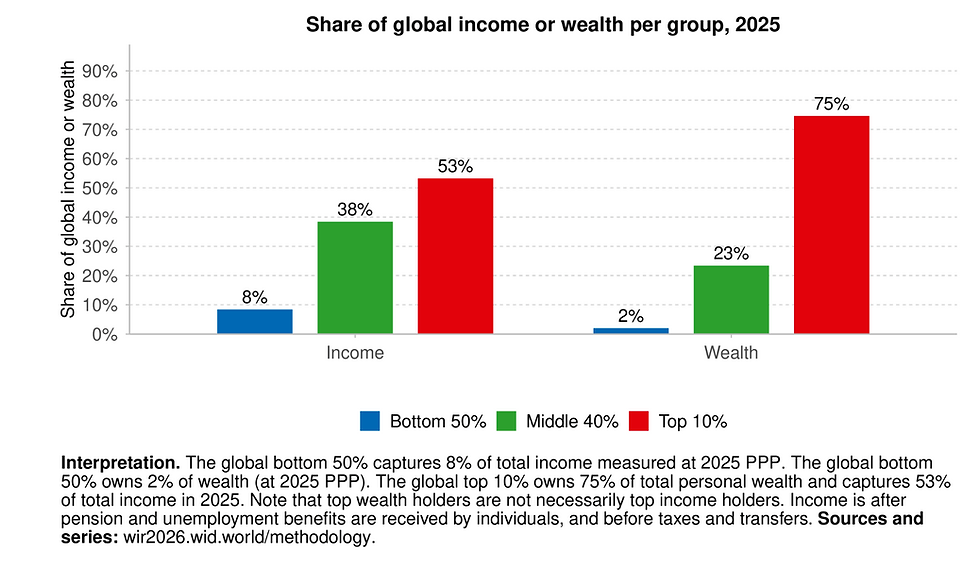
The final, but most important structural driver of migration are the formidable income and opportunity differentials, which still exist between rich and poor countries. Even through inequality between nations is shrinking, the world remains incredibly unequal. Some 75% of global wealth is owned by just 10% of the world's population, while 53% of global income accrues to the top 10% richest - see the chart below. It is ultimately these vast differentials that lead people to set out on perilous journeys to a better life.
To fully appreciate how income differentials can literally make people completely up-end their lives, let us look at some basic numbers. In Africa, workers survive on less than 3 Euros a day, while in Germany a worker on minimum wage gets paid 14 Euros an hour! If the German and the African workers both toil for 10 hours then the German takes home about 50 times more than the African, in addition to working under far better conditions.
Fifty times more income is a powerful incentive! To see just how powerful, imagine we offered the German worker on minimum wage precisely such an incentive: he can choose between continuing to work in Germany for EUR 35,000 gross per year, or he can migrate and get paid EUR 1.75 million instead! I suspect many Germans would opt to migrate without much second thought. The point is this: you cannot hope to stop migration as long as the income differentials are that large!
______
Why will the drivers of global migration get stronger over time? For one, income levels will continue to rise, because income is driven by technical progress, which will not stop. As for transport, the growth of electric propulsion is already providing serious competition for fossil fuel-driven vehicles leading, so this should usher in cheaper transportation for everyone. In communications, too, Elon Musk's Starlink will soon face materially stronger competition, which will make internet services even more accessible and affordable than they are today. The only thing that could could conceivably weaken migration pressures over time is a narrowing of income and opportunity differentials between rich and poor countries, but this only occurs through increased migration, which is still in its infancy.
______
Having said that, not all countries will gravitate towards the global population mix at the same speed or even to the same extent due to important frictions that will slow or even hold up population mixing in the short term in some places. Natural barriers, such as great distance, oceans, mountain ranges, deserts, language, etc. will make cross-border migration more cumbersome in some parts of the world than in others.
The most immediate barrier to global integration right now is the surge in anti-immigrant sentiment in Western economies. The paranoia over the influx of Moroccans to Spain's north African enclave of Ceuta is a case in point. In response, Italy's Prime Minister Giorgia Meloni was quick to call for suspension of Schengen border rules between Italy and Spain. There is no land border between Spain and Italy, so a suspension of Schengen rules would achieve little other than create hassle for those who fly between the two countries. Personally, I doubt that any of the Moroccans in Ceuta will fly to Italy anytime soon. In fact, most of them have already returned to Morocco at the time of writing.
Still, the fact that Far-Right populists like Meloni and xenophobes like Mette Frederiksen in Denmark are ready to sacrifice European integration solely to deter immigration tells you everything you need to know about the state of politics in the West today: a lot of political capital can be harvested by demonstrating overt animosity towards immigrants right now.
However, over the long run the ebbs and flows in xenophobia will be mere gyrations around the structural trend of rising cross-border mixing. Culture-based objections to immigration will also slowly be undermined as successive generations of young people become ever more globalised in their outlook due to their exposure to global social media.
The other reason why xenophobic politics eventually reverses is cold economic necessity. As I explained elsewhere, the number of Europeans aged 65 or over will increase by 25 million by the year 2040, while the number of working age Europeans will decline by 20 million over the same period. For reasons of demographics alone, the European economy will need another 45 million workers just to maintain current levels of prosperity. It is difficult to see how a population gap of that magnitude can be closed without significant immigration.
______
Still, it would be wrong to under-estimate the magnitude of the near-term cultural barriers to immigration. Cultural anxiety is sky-high, especially in rich countries. Strong economic arguments in favour of immigration curry no favour with voters if they are too culturally anxious to listen to rational argument.
Defensive attitudes towards foreigners can be traced back to the very origin of culture itself. Early human communities were tiny and isolated, which rendered them vulnerable to external attacks, so to reduce their vulnerability they developed cultural mechanisms to reduce internal divisions and encourage unity in the face of external threats. These mechanisms are still deeply embedded in the collective psyche today.
This is why rich countries often require immigrants to leave their cultural baggage at the border and adopt local customs instead. I call this Culturalism, meaning the cultural equivalent of racism. Where racism assigns priority to one race over other races, Culturalism assigns seniority of one culture over other cultures.
Most Westerners are Culturalists without even giving it a thought. Culturalism feeds on the profound asymmetry between how much people know about their own culture and how much (little) they know about other cultures. Most people are familiar with their own culture to the point, where they can barely demarcate their own personal values from the shared values in their societies. On the other hand, they have almost no understanding of other cultures. Such information asymmetries are readily exploited by politicians. Far-Right populists judge immigrants by their worst behaviour and constantly reinforce prejudices, while ignoring or actively down-playing injustices and discrimination carried out by the local population.
Sadly that means that all sense of proportion is lost. The truth is that immigrants pose no more threat to anyone than locals. The vast majority of immigrants are ambitious risk-takers, who invested hugely to come to rich countries to work in order to improve their lives. This is backed by the data; statistics consistently show that immigrants make significant net positive contributions to host economies.
______
That is not to say that immigration will have no influence on domestic culture. The question is whether such such influence is pernicious. Suppose an Italian moves into a typical Danish neighbourhood. Does the arrival of the Italian threaten Danish culture? Will his arrival stop Danes from eating Frikadeller and force them to eat pasta instead? Will Danes have to ditch Protestantism in favour of Roman Catholicism? Will they have to stop wearing drab Danish clothing in favour of dapper Italian haute couture?
The answer to these questions is obviously no. Immigrants do not force anyone to do anything. However, some Danes may certainly choose voluntarily to adopt some Italian habits. They might start to dress better. Some may even begin to eat a healthier Mediterranean diet, especially if they have had a few helpings of their new neighbour’s most excellent Spaghetti alla Puttanesca!
Should this be ground for concern? I would argue not. If Danes choose to eat more Italian food, then so be it. A simple truth often forgotten in the heat of the immigration debate is that culture is not immutable. Culture does not need protection nor enforcement. Nor must culture be preserved at all cost. Culture retains its relevance only as long as it is meaningful. If parts of our culture lose relevance, then we ditch them. Similarly, we seamlessly assimilate cultural elements from outside our own culture if those elements seem relevant and meaningful to us. This is how cultures have always evolved and it is generally a healthy and entirely natural process.
We need to bear these things in mind as we think about ways to overcome cultural anxiety towards foreigners in a world that will only get smaller and more integrated. We must remind ourselves that we now have rule of law, democracy, human rights, and modern nation states. We no longer need to barricade ourselves within tight cultural enclaves in order to be safe. Indeed, the cultural instincts we developed in ancient times to defend ourselves against outsiders are now largely obsolete.
Indeed, I would argue that as the world integrates further the winners will be found among those who are most open to other cultures. To be successful in a globalising world, we need to play in multi-cultural spaces. Making a friend of immigration is the way to win in the world of tomorrow.
The End


Comments