
Is there safety in the US Treasuries trap?


Source: here
In London some years ago, I met with the Chief US Economist of one of the world's largest investment banks, which shall remain nameless to protect the guilty. The topic of discussion was the US economic outlook. At the time, many market participants worried. The stock of US debt was large and growing, there were inflation concerns, signs of growing policy populism, threats of protectionism, geopolitical tensions, and clear evidence of bubbles in some markets. Not a great environment growth and certainly not a great environment for US public finances either.
"Should investors sell their US Treasuries?", I asked the Chief US Economist.
He smiled and dismissed my concerns with a swipe of his hand. Then he said something along the following lines,
"A wholesale exodus of investors from US bonds is impossible! Who would buy all the Treasuries? And where would all the money then go? What would investors buy instead? There is no investable alternative to US Treasuries! No other markets is nearly large or liquid enough!"
His words stuck with me. They were clearly meant to reassure me. His point was that if investors really tried to sell their US Treasuries, then the buyers will inevitably have to come from somewhere else in the West. A liquidation of Western government bonds in aggregate is therefore impossible. Bond prices can therefore not fall very far and Western currencies, such as the Dollar, cannot collapse. Volatility? Some perhaps, but collapse? No.
Of course, if he had been less diplomatic, then he would simply have said, "Sorry, you are trapped in your position! Live with it!"
I often hear this type of defence, when I raise concerns about unpriced risks in Western financial markets. Still, was the Chief US Economist right about what he said about the size of markets and the lack of alternative investments? Are global financial markets really so skewed towards the West that investors genuinely have nowhere else to go, wherefore prices can never fall very far?
There are two parts to this question. Let us first look at the structure of global bond markets. The Bank for International Settlements (BIS) collects and publishes data on outstanding government securities. As the chart below shows, some 70% of all outstanding long-term general government debt has been issued by developed economies (as of the end of 2025). The US government alone accounts for 42% of this total and 30% of all government debt in the entire world.
Chart 1: Composition of global general government debt

Source: here
Moreover, the vast majority of US Treasuries are owned by institutional investors, such as pension funds, insurance companies, central banks, and sovereign wealth funds. From experience, I know these types of investors allocate the vast majority of their assets to developed markets. They also happen to be extremely slow movers. Bound by written investment mandates with the asset managers to whom they outsource the daily management of their portfolios, they can only make major shifts in allocation after lengthy processes involving new manager searches, new documentation, etc. Most of them would not, even in crises, be able to make meaningful shifts out of Western markets into, say, Emerging Markets. In fact, the record shows that most tend to buy (moderate amounts of) developed market debt during crises, not sell.
It would therefore appear that the Chief US Economist was right on his first point. There really are not enough alternative assets to buy should Western investors cut and run from their own home markets, at least not in the short run.
Now, let us look at the second bit of his statement, namely that Western asset prices cannot fall very far. Unfortunately, this is pure nonsense. The fact that Western investors have no alternatives to US Treasuries does not mean that they should feel safe.
What the Chief US Economist omitted to say was that prices of financial assets, including US Treasuries, can and absolutely will re-price in major ways during crises, even if the assets never leave the group of current holders or the region in question.
Currencies can re-price for exactly the same reasons.
Here is how re-pricing happens in the real world. Suppose an American pension fund gets uneasy about the outlook for the US public finances and decides to offload a big block of bonds. Suppose the bonds currently trade in the market at a price of 100c. In order to get the bonds off its books as quickly as possible, the pension fund offers them at 95c. Some other US pension fund looks at the price and thinks, "Wow! A 5% discount! Great deal!" Remember not all investors have the same view, which is precisely why markets exist. Unfortunately, events soon prove the original seller right and the pension fund that just bought the bonds at 95c regrets its purchase. It now thinks the bonds have way more downside, so it puts them up for sale at 80c. Before long, a third US pension fund appears and says, “Gee! They’re already down 15%! That is great value! Gonna get me some!”
And so on.
This is how assets re-price in the real world. Perhaps the best real-life example is the re-pricing of the S&P500 US stock market index during the 2008/2009 Global Financial Crises (see chart below). This most traded of US equity indices dropped nearly 900 points from a peak above 1,500 in autumn of 2007 to a low of 666 in the spring of 2009. Throughout this enormous re-pricing, all stocks continued to be owned by someone (of course) and the vast majority of owners remained within the United States during the entire time.
Chart 2: Re-pricing of the S&P500 during the Global Financial Crisis
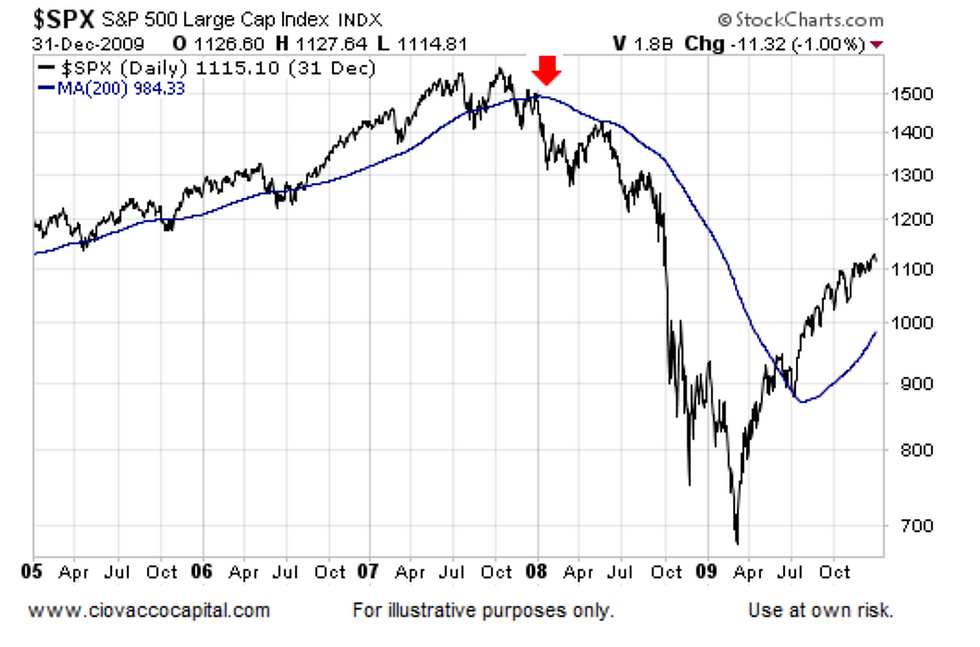
The fact that these investors had nowhere else to go (or did not want to go anywhere else due to home bias) offered them no protection whatsoever. The losses occurred regardless, because the market must eventually reconnect prices with the true worth of the assets. This reconnection happens through repeated buying and selling of bonds, with investors taking profound losses along the way, until, after much trial and error, some notion of fair value is re-established.
So, the next time someone fancy tells you that you are safe, because you have nowhere else to go then tell them they are completely wrong.
The question is quite relevant right now, because US bond markets are currently experiencing jitters very similar to those that occurred around the time of my meeting with the Chief US Economist. The Trump Administration is doing its damndest to pursue policies, which make even the most reckless Emerging Market governments look positively angelic.
Yet, many investors remain in denial. Most still can't quite make themselves believe that the US Treasury market could go belly up. Maybe it won't. Maybe it will. But if it does, believe me, you and every other sucker out there will be looking at major re-pricing of every asset you own from government bonds to AI stocks to the Dollar itself, even if every single asset you own never crosses a border.
The End


Comments