
Open kimono

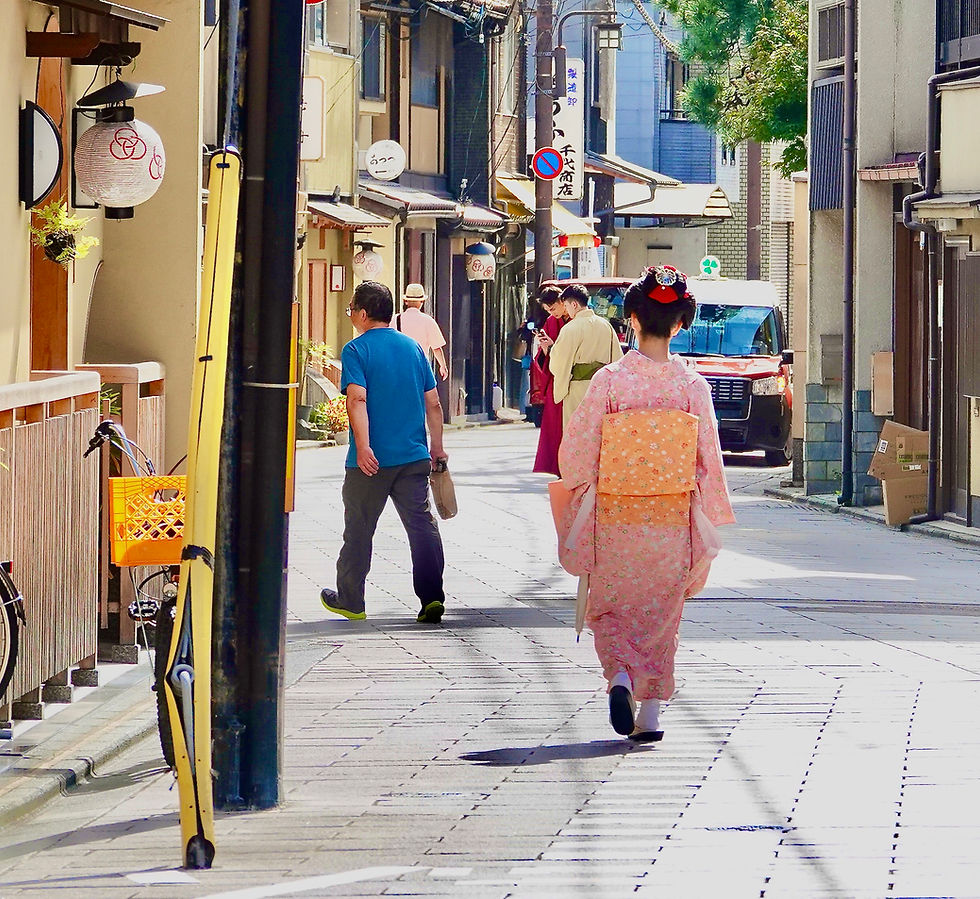
Gion geisha district in Kyoto (Source: own photo)
In her most recent missive Stop Pink-Washing Patriarchy, Alice Evans argues that gender studies place too much emphasis on celebrating a few "kick ass" female success stories instead of focusing on the broader empirical reality of women's status in society.
While it may feel empowering, exciting and rebellious to tell happy stories about women, who have attained power and prestige, the truth is that such cases are often the exception rather than the rule.
The focus on a few success stories, according to Evans, takes the focus away from the far more important bigger picture of women's role in society, which is one of great divergence; there have been "colossal progress" towards gender equality in some regions of the world, while women in other parts of the world continue to suffer in stubbornly persistent patriarchies.
–––––
Evans' point resonates strongly with me. It struck me especially during a recent visit to Japan, where I visited Kyoto's Gion geisha district. During the visit, I heard geishas described in a heroine-like manner - as highly respected and skilled and accomplished multi-artists. I have no doubt that this is true, but it also made me think that maybe the geishas and their accomplishments are not reflective of women's status in Japanese society, both today and in the past.
In the rest of this blog, I explore this topic further; what, exactly, was and is the relationship between geishas and sex work and how representative is it of sex work in the rest of the Japan? And what about women who are not sex workers? How are they treated in Japan?
______
Let us start the exploration by taking a trip back in time to the era of the Tokugawa shogunate, which lasted from 1603 to 1868. It was during this period, when geishas first became a 'thing' in Japan. Today, there are just shy of 200 practicing geikos (as geishas are called in Kyoto) in Kyoto plus another 100-130 apprentices, who are called maikos. A good way to learn about them and the Tokugawa shogunate is to join a geisha tour through a few of the geisha districts in Gion. A tour lasts a couple of hours.

The lamp with the three 'unity' red circles show us we are in a geisha distict, while the frame with the two name boards on the wall to the right of the door tell us that geishas live in this house (Source: own photo)
I knew nothing about geisha culture before joining the tour. However, it became clear to me quite quickly that prostitution is a sensitive topic in geisha guiding circles. We had barely begun our walk, when the guide unprompted stated that geikos (and maikos) are not prostitutes. Instead, she explained, they were (and are) independent and highly skilled artists, who entertain at private banquets and tea houses. Their skills, which are acquired through years of diligent apprenticeship, include hospitality, playing musical instruments, traditional dancing, and having witty conversations. But absolutely no sexual services. The guide went on to blame the popular book Memoirs of a Geisha for damaging the reputation of geishas by alleging non-existent links to prostitution.
_____
As the tour wore on we got deeper into the subject of geishas and their role in Japanese society and the picture slowly began to blur. While our guide is absolutely correct that today's geishas are not prostitutes, this has not always been the case. Geishas provided sexual services prior to 1779, when a law was introduced that confined the activities of geishas to non-sexual activities. Even so, geishas to this day mainly cater for men and their services continue to be available only within districts, which were once designated for high-ranking courtesans (oirans), who most certainly were sex workers. In other words, it is arguably more accurate to say that geishas are a hyper-specialisation within a system that in every way was and still is designed to service men.
_____
It is also important to understand that the 1779 law to ban geishas from sex work was implemented to protect prostitution, not to abolish it. At the time, the high-end prostitution business was incredibly lucrative and, of course, 100% controlled by the shogun. It supplied a huge chunck of the shogunate's tax revenue. To give a sense of the scale of the business, consider that a single night with an oiran courtesan could cost the client the equivalent of 40,000-50,000 US Dollars in today's money. Around 40% of this revenue went directly into the shogun's coffers, making the tax take from prostitution in Gion and other geisha districts in Japan extremely meaningful.
The price of oiran courtesan services was eye-watering, especially when you take into account that prostitution was rife throughout all sections of Japanese society in the Tokugawa period. If sex could be procured everywhere and anytime for a mere pittance, why on earth would anyone pay the equivalent of a year's salary of an average worker to be with a prostitute for just one night?
Well, the business of hiring an oiran courtesan for a night had very little to do with sex. Instead, it was all about demonstrating wealth and status. The Tokugawa shogunate operated a rigid caste system in which merchants occupied the very lowest rung. Yet, many merchants became extremely rich for reasons I will return to shortly. Because of their low rank in society, however, they had limited ways to spend the money, because the caste system imposed strict rules on what they could and could not consume. For example, merchants were barred from buying high-quality clothing, prestigious weapons, such as samurai swords, and other types of extravagant household items. They also faced severe limitations in terms of the size, height, and decorative extravagance of the homes they were allowed to own.

Shogun era garden (Source: own photo)
The act of buying the sexual services of an oiran courtesan therefore emerged as an important way for wealthy merchants to demonstrate their social status, since only a tiny fraction of Japanese could ever afford such opulence. While being seen to spend a lot of money was the chief objective of hiring an oiran courtesan, the merchants were not entirely insensitive to bargains. When geishas first emerged, they were carbon copies of oirans except they had yet to be codefied in the tax system. They enabled them to offer identical services to oiran courtesans, but at a 40% discount! Unsurprisingly, geishas soon became incredibly popular and the oiran business model and, by implication, revenue prospects for the shogun took a hit.
The sole purpose of the 1779 law was to stop the leakage of tax revenues caused by geisha prostitution. The law achieved this aim by establishing clear boundaries between geishas and oiran courtesans, which were policed by registry offices known as Kenbans. Kenbans regulate and oversee geisha operations to this day.
–––––
Geishas were thus able to sell services without also selling their bodies from 1779 onwards, but they along with oirans had only made up 2% of all sex workers in cities like Kyoto and Tokyo. The remaining 98% of prostitutes in Japan lived very different lives. To understand the conditions they faced, we need a quick overview of the structure of Tokugawa shogunate society. As mentioned earlier, Tokugawa shogunate society was a strict caste system, which placed merchants at the bottom. Above them were farmers, who were deemed more important, because they produced food. Above them were the samurai, which ensured that everyone followed the rules, and then finally you had feudal lords at the top. They pledged allegiance to the biggest feudal lord, who was called the shogun.
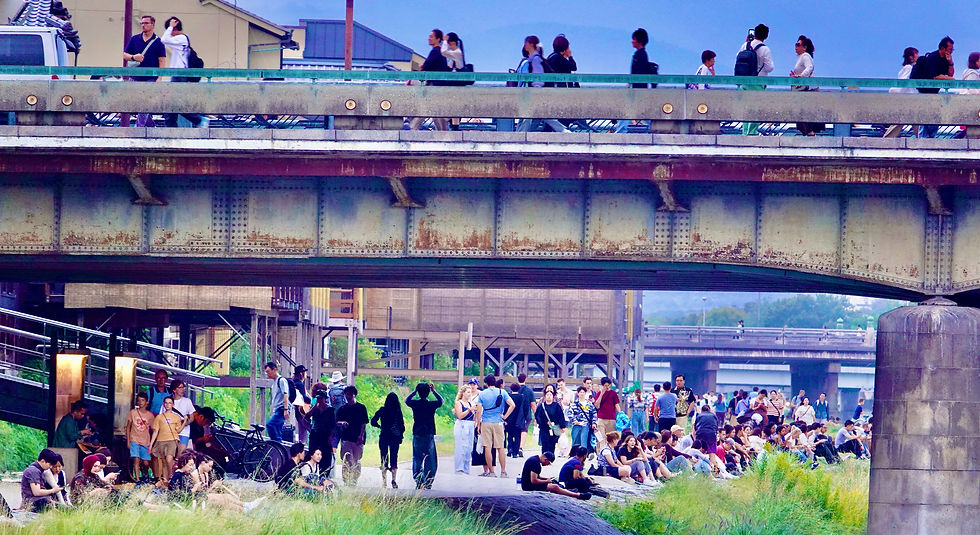
Locals and tourist mingle along the river in modern Kyoto (Source: own photo)
Wealth in Tokugawa shogunate society derived from owning land and engaging in trade. The model strongly favoured the shogun and the feudal lords, because they owned all the land, which they taxed heavily. The system also benefitted urban merchants, who acted as middle-men in trade between all tiers in society as well as providers of finance.
The big losers were the samurai and farmers. Both groups were paid in kind in rice. This made them vulnerable not only to production and price shocks, but also forced them to trade in a barter system, which usually put them at a major disadvantage to the merchants in terms of market power. The system operated in such a way that it all but guaranteed that samurai and farmers made losses and they soon become chronically indebted.

Locals take a moment to enjoy the sight of a bird on the bridge (Source: own photo)
Farmers were particularly badly affected, because in addition to having to barter rice on bad terms they were also heavily taxed by the feudal lords. When the crop failed, the taxes (payable in rice) still had to be paid, which gave farmers no choice but to take out high-interest loans from wealthy landowners or merchant moneylenders. If the farmer could not repay the loan, he would be forced to sell daughter into indentured servitude as a desperate, last-resort financial survival mechanism. However, this happened with such frequency that farming debts fuelled the entire supply of prostitutes throughout the entire Tokugawa shogunate.
The supply of girls - usually 12-15 years of age - was nearly unbroken. The girl's labour rarely if ever cleared the original farming debt. Brothel-owners billed food, shelter, expensive kimonos, cosmetics, medical care for sexually transmitted diseases, and even the interest on the original advance loan back to girl. In most cases, she could never earn enough to buy her freedom and if she died or became too ill to work the remaining debt would fall back on the impoverished farmer, who would then have to give up another daughter and the system would thus repeat. This went on for more than 250 years.
–––––
The conditions facing geishas and oiran courtesans during the Tokugawa shogunate era were clearly not representative of the conditions that faced the vast majority of sex workers in Japan in this period. The overwhelming majority had no training or fancy gear and sold their services in highly competitive markets, which drove prices right down. Many conducted business as de facto slaves in licenced (read: taxed) redlight districts, brothels that were allowed to operate along major trade routes, in illegal brothels, or as street walkers. The latter were often older women, runaways, or those suffering from visible advanced stages of sexually transmitted diseases, wherefore they wore heavy white makeup to mask their illness.
–––––
Even those women who were not sex slaves faced subjugation within strictly male-dominated hierarchies that reached across all tiers in Tokugawa shogunate society. The primary wives of the shogun himself and the feudal lords lived in gilded isolation with status over the concubines, but had no political power. The concubines bore most of the shogun's children, but were subject to constant monitoring to ensure that they never conspired against their master.
In the warrior class, samurai women had to exhibit absolute obedience to fathers, husbands, and in-laws. Their primary duties were to manage the household, breed, raise heirs, and uphold family honour. They were not even allowed to move about freely outside the household without official permits.

Lovely gardens in Kyoto (Source: own photo)
Female farmers had more freedom, but only because their commercial contributions were essential to making ends meet and to avoiding, if possible, having to sell daughters into sexual slavery.
In case of discord, Confucian society generally granted husbands easy divorces if they deemed wives to have failed to meet expectations, which brought immense social stigma to the woman. Men could openly keep concubines, but women would be severely punished, killed even, if they were unfaithful.
–––––
Japan has obviously changed a lot since 1868, when the Tokugawa shogunate collapsed as a result of a rebellion led by samurai. Still, many argue that Japanese society remained feudal until after World War II. For example, land was not redistributed from feudal lords to farmers until 1946 under the direction of General MacArthur. Today, women have the same rights as men under the law, but cultural traditions take time to change. Women still only hold 13.6% of seats in the Japanese parliament. Women tend to drop out of the labour market after giving birth and then not returning. When they work, women tend to have lower-paid jobs with worse benefits than men. Japan also has one of the widest male-female wage gaps in OECD. Men do less than an hour of housework on average and only very rarely do men make use of paternity leave.
Some people even argue that the current Prime Minister, Sanae Takaichi, a woman, is not the most powerful person in the country despite the powers vested in her office under the constitution. Her Chief Cabinet Secretary, Minoru Kihara, a man, is seen by many as wielding even more power than her behind the scenes on account of deep connections to Japan's big industrial groups as well as the yakuza, which are strictly patriarchal, male-dominated criminal organizations that reflect traditional male-dominated hierarchies. No fewer than nine former Prime Ministers, including Shinzo Abe, Yasuo Fukuda, and Yoshihide Suga held positions as Chief Cabinet Secretaries before they became Prime Ministers.
–––––
So, as far as Japan is concerned, I do think Alice Evans has a point. It would be doing a disservice to Japanese women to focus too much on the geishas’ undoubted advances and accomplishments, especially if doing so means not seeing clearly enough the huge job that still remains in levelling the playingfield for men and women in Japan today.
The End



Comments