
Sucre's Cal Orcko dinosaur prints

Updated: Dec 15, 2025

T-rex at the Sucre dinosaur visitor center (Source: own photo)
STOP PRESS: On 3 December 2025, the PLOS One journal published mind-blowing findings from a new Bolivian dinosaur site in the Torotoro National Park. The article, which is also discussed here, documents 1,321 trackways and 289 solitary tracks for a total of 16,600 dinosaur foot prints. In addition, the Torororo site revealed 1,378 swim tracks as well as several tail traces plus numerous avian tracks, all within a total area of 7,485 square meters. The Torotoro site is significantly larger than Cal Orcko, making it the largest in the world. In other words, Bolivia can now truly call itself Dinosaur Nation, being home to the two largest track sites in the world.
_____
The rest of this blog post tells the story of the discovery of Cal Orcko.
_____
Sucre, they say, is all about the past. The Spanish first settled in Sucre in 1538 after arriving from the north. It was also in Sucre where the independence declaration was signed some 200 years later. Sucre feels it has done enough, that it can rest.

Sucre (Source: own photo)
And rest Sucre does. Nothing much happens in the town. The government moved to La Paz in 1898 after a civil war and the country's most important commercial centre is a 45-minute flight away in Santa Cruz.
Only the Supreme Court and the locale of the Roman Catholic Church are still based here, but everyone knowns Sucre's status as capital of Bolivia mainly rests on its historical importance.
Visitors perceive Sucre as a quiet, beautiful little town with narrow streets and white Andalucian-style houses, pleasant squares, churches, museums, hotels, and restaurants. The climate is good and there is only one industry in town, namely the FANCESA cement factory on the edge of town.

The FANCESA cement plant (Source: own photo)
In 1959, when FANCESA first opened its doors for business no one had the faintest idea that this large and rather ugly plant would one day be the cause the biggest upheaval in Sucre's history for 130 years.
Granted, FANCESA's importance extended far beyond Sucre from the start. The factory was the second cement plant ever to be built in Bolivia, so nearly half of all buildings in the country owe their existence to the factory.
However, this is not the main reason for FANCESA's importance. The factory's true significance was only revealed some 25 years later after engineers at the factory encountered a stratum with unusually high levels of magnesium, which made the limestone unsuitable for cement production. Production stopped and moved to the backside of the mountain, leaving behind a huge rock-face, which is visible from every corner of Sucre.

The Cal Orcko rock face (Source: own photo)
Around this time, a geologist employed by FANCESA noticed some strange markings on the abandoned rock-face. He took some photographs of the markings and sent them to palaeontology departments in Santa Cruz and La Paz, but no one took any notice. A decade passed.
Then, in 1994, Klaus Schütt, a Bolivian film-maker and amateur palaeontologist of German descent, paid a visit to his old school friend, who happened to work as engineer at the plant. During the visit, Schütt was given a tour of the factory, including a stroll along the old abandoned rock-face. Schütt saw the markings and immediately knew they were not random; they were dinosaur foot prints.

Schütt knew they were foot prints (Source: own photo)
Legend has it that Schütt's friends, all of whom were hippies in their youth, thought he had smoked a bit too much weed. However, Schütt was a determined man. He made it his mission to bring the world's attention to the dinosaur prints. He believed that Cal Orcko, the name that was later given to the abandoned rock face, contained some 3,000 dinosaur foot prints. He filmed the prints and over the next four years sent his footage to all major Bolivian, US, and European palaeontology university departments.
No one replied; they did not believe the prints could be real.
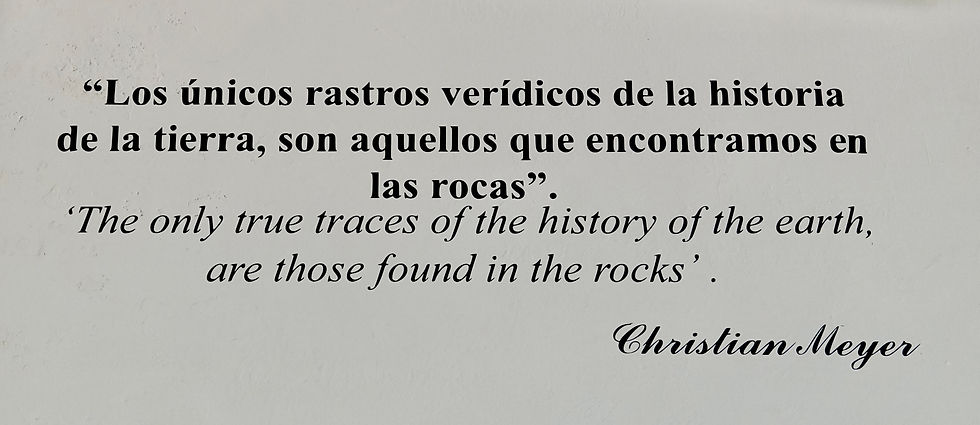
Until four years later, in 1998, that is, when Schütt's film landed on the desk of the Swiss palaeontologist Christian Meyer, who was the first professional palaeontologist to believe the prints were real and the first to truly fathom the significance of Schütt's discovery.

Meyer's first visit (Source: own photo of picture in the visitor centre)
Meyer paid a visit to FANCESA the very same year during which he established that Cal Orcko did not, in fact, contain 3,000 dinosaur prints as Schütt had claimed, but rather 5,000 foot prints from at least 8 dinosaur species.
Meyer was a stoner (Source: own photo)
Meyer was also able to determine that the prints were from the Late Cretaceous period some 60 million years ago, just prior to the Great Extinction, which wiped out all dinosaurs.
The Cal Orcko rock face today (Source: own film)
Today, the Cal Orcko dinosaur site is recognised as the largest and most diverse collection of dinosaur prints in the world. More prints were found after Meyer’s visit; it is now known that there are more than 12,000 foot prints at Cal Orcko, many of which are more than one meter in diameter. They were made in what was once an ancient, muddy lakeshore and later lifted into a steep wall by tectonic forces.

A small section of Cal Orcko (Source: own photo)
It is somehow fitting that the renaissance of a town as historical as Sucre has been triggered by a historical event, albeit a far more distant one. A large facility is currently being built at the foot of the rock-face with viewing platforms to enable larger numbers of visitors to get up close and personal with the dinosaur prints. Cal Orcko is destined, I am sure, to become Sucre's most important tourist attraction.
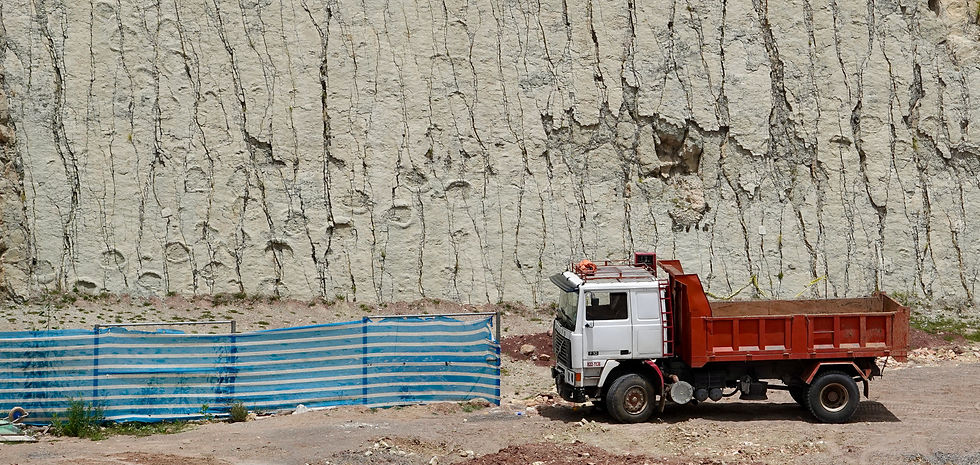
Construction has begun on the visitor centre (Source: own photo)
I also find it thought-provoking that a unique world-class palaeontological treasure like Cal Orcko could sit undiscovered for nearly two decades within full view of the entire town of Sucre. It makes me wonder how many other treasures are out there, hidden in plain sight?
The End


The dinosaur print activity shared in the post felt creative and engaging, especially how simple art projects encourage children’s imagination. I once helped my younger cousin with a similar craft project while juggling university deadlines and decided to do my assignment later after finishing the activity. It made me realize creative moments with kids can refresh the mind and even improve focus when returning to academic work.
I read the post and it’s honestly fascinating how it talks about ancient dinosaur footprints in Sucre and how something so massive stayed hidden in plain sight for millions of years. It made me think of a time when I was overloaded with exams and I once considered Affordable online finance class help just to reduce stress and stay on track. That moment showed me how pressure can push people to look for easier paths, but reading this reminds me that real discoveries and progress always take patience and time.