
Tuamotus Odyssey


Happy humpback in Moorea (Source: own photo)
A year or so ago, a small group of friends and family came together and decided to go sailing in French Polynesia. In addition to Hnin and myself, our little team comprises my brother Morten and his wife Sanne as well as friends Liam and his wife Cami. Hnin, my brother, and I have some experience of ocean sailing after taking my yacht Twende across the Atlantic Ocean some years ago, but on this trip, we have handed the controls to Liam and Cami, who are far more experienced sailors than the rest of us.
The Tuamotus team (Source: own photos)
Hnin and I know Cami and Liam from Spain. We went to their wedding in Bolivia in December 2025. They have run yacht charters for years. Liam is a fully qualified ocean skipper. He brought Twende safely back to Europe from Grenada against the prevailing winds in 2023. We will need this kind of experience on this journey. Late October is the start of the so-called shoulder season in French Polynesia, when wind and waves begin to play havoc with sailors. Besides, this is the worst El Niño year on record, so literally anything can happen.
____
Why French Polynesia? For one, it is an exciting cruising destination. French Polynesia is a collection of some 120 islands spread over five distinct archipelagos that cover an area of more than 5 million square kilometres. For context, that is 20% larger than the size of the European Union.

French Polynesia (Source: here)
The best-known of the five archipelagos in French Polynesia is the Society Islands, which includes famous tourist destinations, such as Tahiti, Bora-Bora, and Moorea. The tall, green and picturesque Society Islands are surrounded by coral reefs and are home to the vast majority of the people, who call French Polynesia home.
Far less well known is the vast and extremely sparsely populated chain of low-lying coral atolls that make up the Tuamotus archipelago. This part of French Polynesia is a best known for excellent scuba diving, black pearls, and splendid isolation. Then, to the north-east you find the Marquesas Islands, which is the first part of French Polynesia you reach when you sail across the Pacific from Panama. To the far south lie the Austral Islands, while you find the truly remote Gambier Islands all the way down in the south-eastern corner of French Polynesia.
____
It has been my wish to visit the islands of French Polynesia for as long as I have known of their existence. I have vague memories from early childhood of palm trees and lovely-looking brown people and typhoons, probably from images I saw in some long-forgotten cartoon. My desire to visit the islands deepened after I began to sail and snorkel in Tanzania in the 1980s. I got even further drawn in after reading Troels Kløvedal's romantic tales of sailing the South Seas in the 1970s. The prospect of one day visiting French Polynesia was also a major motivation behind my decision to forsake university after high school in order to train as a boatbuilder instead. When I bought Twende in 2021, my aim was always to spend considerable time in the South Pacific. Unfortunately, things did not quite turn out as I had hoped and I never made it here on that occasion. Now is my chance to finally explore this enchanting part of the world.
____
After months of anticipation and preparation, October 2026 is finally upon us and suddenly this long-awaited sailing odyssey in French Polynesia is about to begin. Our principal destination is the atolls of the Tuamotus, which are among the most remote and challenging sailing destinations in the world. For one, the +70 atolls are very, very far away. It took us more than a week to reach Tahiti, albeit with a few stops along the way. We are 11 time zones away from Europe and we had to cross the international date line to get here. From Tahiti, it will take another several hundred nautical miles of difficult upwind sailing to reach the Tuamotus.

Our planned route - the first cut (Source: own photo)
Our plan is to sail from Tahiti via Moorea to the uninhabited atoll of Tahanea in the Tuamotus and then 'atoll-hop' with the wind to Fakarava, Toau, Rangiroa, and Tikehau. On the way back to Tahiti towards the tail end of November, it would be interesting also to pay a visit to Makatea. The whole journey is about 1000 nautical miles and should take us around three weeks.
It is not a journey without risk. For one, the Tuamotus atolls have never been an easy sailing ground. The atolls used to be called the 'dangerous archipelago' before the arrival of modern GPS navigation technology on account of countless uncharted and low-lying reefs. Besides, at this time of year, especially in an El Niño year, nothing can be taken for granted when it comes to weather and the sea state; wind and waves will ultimately dictate what we can and cannot do.
____
Four of our six-member team arrive from Japan on 26 October. Liam and Cami join us the following day from San Francisco, having taken the shorter route from Europe to French Polynesia via the USA. I opted against this route despite the shorter distance, because I write scathing things on social media about the American paedophile Donald Trump, which, these days, can land me in a torture jail in El Salvador.

Morten and me at the car rental at the airport in Papeete (Source: own photo)
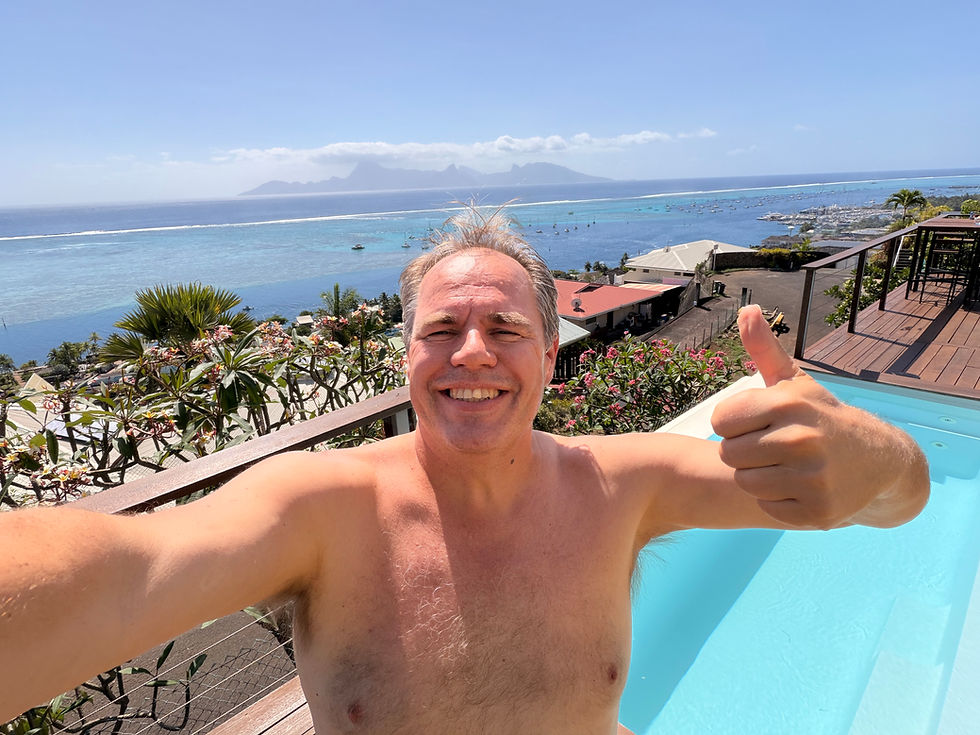
We rent an Airbnb for a few days, so that we have time to adjust to the time zone, provision for the trip, and see Tahiti itself. Our Airbnb hosts meet us in the airport and place leis (flower garlands) around our necks in accordance with Polynesian custom. We rent a van and drive to the house, which sits on the north-western slopes of Tahiti with stunning views of the Tahiti shore-line below, where humpback whales leap from the water just beyond the reef. Some 17 kilometres away across Te Moana-o-Marama strait lies the island of Moorea.

View from the Airbnb (Source: own photo)
Over the next couple of days, we take the opportunity to drive around the island of Tahiti, stopping along the way to take in the many beautiful sights. It is a lush island with steep mountain sides, deep gorges, and many rivers. A reef with white breaking surf surrounds the base on all sides.
Birding along the western coastline in Tahiti (Source: own photos)
In the evenings, we eat food from roulottes, which are food trucks that serve goodies like raw tuna in coconut milk and generous slices of grilled mahi-mahi on warm rice. Morten goes into the hills in search of endemic birds. The locals we meet are beautiful people, some very fat, others extremely well-built. All of them are gentle, warm, and friendly, although in the backstreets of Papeete we also see some of the island's many fentanyl addicts. Nearly everyone we meet speaks Tahitian, French, and decent English.
____
After we pick up Liam and Cami at Papeete's Faa'a airport on the afternoon of 27 October, our team is complete. Things are about to get serious. Over the following two days, we provision for the trip. In addition to buying generic breakfast and lunch stuff, we each commit to cooking three dinners on board. We feed the 18 recipes into an AI engine, which calculates the required ingredients for a crew of six. Within seconds, Claude produces a detailed list of all the food and drink we need to buy. Armed with the list, we head to the nearest Carrefour and emerge a few hour later with seven full super-market carts brimming with food, water, and other provisions. At the end of the trip, we find that these purchases matched our needs to a tee.
On 30 October, the day before departure, Liam and I go to the marina in Papeete to inspect the 14-meter Excess catamaran we have chartered to take us on this Tuamotus odyssey. Sakura II is a class A ocean-going yacht meaning it has been built tough for big seas and strong winds.
We take the boat for a test sail with Olivier, who is one of the charter company's skippers. He tells us he has only been to the Tuamotus twice during his ten years as a skipper on Tahiti. His limited experience of the Tuamotus is probably representative of most people who sail here; hardly any make the arduous upwind journey to these remote atolls. As we sail out of Papeete harbour, we spot jumping spinner dolphins. In the afternoon, the rest of the crew move onboard.

Ready to go! (Source: own photo)
We spend the first a night on board in the marina in order to get properly installed and also to have enough time for any last-minute provisioning. In the evening, we celebrate the imminent start of our adventure by eating pizzas at the Tribeca restaurant on Papeete's harbour front. A great live band is playing jazz all evening and we drink many beers.

Heading out of Papeete (Source: own photo)
On 31 October 2026 at 9.15 am, we fire up Sakura II's two 57 HP Yanmar engines, cast off, and slowly potter out of Papeete harbour in splendid sunshine. Destination: Opunohu Bay on Moorea's north coast. The winds are too light for sail, so we motor. The crossing takes three hours. On the approach to Opunohu Bay, we see humpback whales jumping out of the water and displaying their speckled tails against the backdrop of the thatched bungalows of a luxury hotel.
Spinners, bottle-nosed dolphins, and a humpback whale at Moorea (Source: own photo)
Liam skilfully manoeuvres Sakura II into a secluded anchorage behind the reef. There is only one other yacht there, which leaves shortly after our arrival, so we soon have the place all for ourselves. The water is crystal clear. Spotted eagle rays and black-tipped reef sharks circle the boat, while large stingrays slither across the bottom and sea eels snake their way past the stern. We throw out a line with a hook only for a large batfish to break it. Elaborate coral formations with an abundance of fish lie just a few hundred meters from the sandy patch upon which we have cast anchor. We snorkel in the afternoon and at night we eat potatoes and poached eggs in tomato sauce.

Sakura II in splendid isolation in Moorea (Source: own photo)
That night we experience the first of several major shifts in weather on the journey. Calm and clear skies give way to heavy rain and thick cloud. The wind also turns from east to south-east and picks up speed. We have more than 25 knots in the gusts. Unperturbed, we spend 1 November at anchor in Moorea snorkelling, spotting green turtles and grey reef sharks around our boat. We eat bread with slices of ham and cheese for lunch and we discuss our coming passage to the Tuamotus in light of the new weather conditions.
____
Plan A is to sail directly to Tahanea, where Morten wants to see the endemic and extremely rare Tuamotus Sandpiper. The more southerly winds should make Tahanea possible, but the stronger winds will also make the seas choppy, which could seriously impede our speed. We hope larger swells from an older weather system forecast to come at us from behind will push through the chop.

Plan A and contingencies (Source: own photo)
However, catamarans do not sail well upwind at the best of times, especially not in rough head-on seas. We therefore also make two contingency plans in case conditions prove too challenging; plan B is to sail to Fakarava South instead of Tahanea, plan C is to head even further west to Fakarava North. More westerly approaches make the journey easier, given the expected wind direction, but regardless of which route we choose we will have to beat several hundred miles into wind and waves to reach our destination. In other words, this is going to be a very unpleasant journey; the Tuamotus better be worth it!
____
With planning out of the way, we take the dinghy to a small landing nearby and trek to top of Magic Mountain, which is a steep hill with great views of Opunohu Bay and Sakura II at anchor. Back at the boat, we eat a salad for dinner before retiring early after a bit of fishing off the stern. Morten catches a small Karambesi, which goes into the freezer as bait for future fishing adventures.
Magic Mountain hike (Source: own photos)
____
On 2 November at 5.45am, we depart Moorea for Tahanea. Ahead of us lie some 300 nautical miles of hard upwind sailing. We call our families to let them that we are off. Just in case.
Conditions are good at first with clear skies and calm seas, but the weather soon sours. The skies darken and the sea turns black. Contrary to our expectations, the wind is actually mainly out of the east, which means directly into our faces. We therefore slam hard into steep oncoming waves. Before long, we are forced to motor. For the next 18 hours, we hammer our way against wind and chop under engine power, yet we only manage a measly 3 knots an hour.
At this rate, it will take us four days to reach Tahanea. Not good.
Then our fortunes improve. The apparent wind swings 45 degrees to the south after midnight and we can put the sails up again. Our speed more than doubles and we no longer need to use precious fuel. The promised swell out of the south also materialises and we get gently pushed towards Tahanea. The sailing is by no means easy, however. We are still close hauled and the slamming continues all night. No one gets much sleep.
On the morning of 3 November, some 24 hours after we left Moorea, we are in good spirits having made it through the night. The food on board is good, but not all of us are very hungry. Sanne and I take pills to keep seasickness at bay. Sanne spends most of the passage drugged up in coma-like sleep, but I stop the medication after two pills. My body appears to retain some muscle memory from the Twende days and I am not nearly as sick as I had feared I might be. Having said that, my seasickness is only a glance away. I function well when I lie down or when I steer the boat; all other activity triggers near-instant nausea. Hnin, Cami, Liam and Morten cope far better with the conditions, although no one on board is feeling particularly chipper.
____
Then the brief spell of favourable wind abrupt ends. The wind swings back towards the east and we are forced to head in a more westerly direction, away from Tahanea. Plan A is dead. Tahanea will not happen. Bye bye Tuamotus Sandpiper! The waves also grow larger and the wind strengthens further. Before long, we realise that Plan B - Fakarava South - is not possible either as we continuously have to bear away in order to make any forward progresss. We now head for Fakarava North in accordance with Plan C.
At this point, we believe it is possible to reach the pass at Fakarava North at the 6 am slack tide next morning, but as the second day at sea gives way to the second night at sea the wind and sea state dash out hopes.
At 2 am on 4 November, I am alone at the helm. Everyone else is in their cabins sleeping or trying to. Suddenly, out of nowhere, the skies open and the wind starts to spin in circles around our boat. It is weird weather, eery even. The wind direction constantly changes and rain splashes hard onto the Garmin instrument panel at the helm station. The auto pilot suddenly cuts out. In less than a second, Sakura II turns sharply to port and we gybe. For a few seconds, I lose all orientation, but I eventually manage to get the Sakura II back on course.
We had similar episodes on Twende; they always remind me never to sail by instruments alone; it is critical to always have a clear sense of where the boat is heading and where the wind is coming so as to be able to recover quickly when the technology fails.
During the next hour, I hand steer through the densest rain storm I have ever seen. It is pitch dark; conditions are atrocious. Drenched with salt water, the touch-sensitive autopilot repeatedly cuts out. Then, gradually, the wind subsides until it dies altogether and there is suddenly deadly silence. I start the engines and begin to motor. When the wind returns with a vengeance after some time, Sakura II goes back to fighting the elements at very low speeds as the Yanmars struggle on.
At this point, it is abundantly clear we will not make it to the pass at Fakarava North by 6 am. In fact, we may not even make the next slack at noon even though we are only 10 nautical miles away. If we fail to make the noon slack, we have a major problem on our hands. We will have to wait in very rough seas outside the entrance of the atoll for twelve hours until the next morning slack, because there is not enough light to enter the pass during the evening slack around 6 pm. Entering the atolls in the Tuamotus requires good light and the sun high in the sky, so we can see the narrow entrance, the bommies, and any standing waves clearly.
Realising the gravity of the situation, Liam puts the engines on full throttle and we power ahead, hoping that we will have enough fuel to make it. It turns out to be one of Liam's many excellent decisions as captain on this trip, because we reach finally Fakarava North with mere minutes to spare.
Fortunately, the pass is calm with a slight ingoing tide, so we glide inside and once inside the atoll the waters are so calm that it is almost impossible to imagine that we just made one of the most gruelling passages of our lives. We turn to port and head up to a little settlement in the north-east corner of the atoll.
The sail from Moorea has taken us more than 55 hours. When we look closer at the data, we discover that we have covered the distance at an average speed of 5 knots per hour, which surprises us, but, as we are now only too keenly aware, averages do not tell the whole story.
____

North Fakarava after the tough journey from Tahiti (Source: own photos)
Jaded but relieved, we muster the energy to run the water-maker and wash salt off the boat. We clear up the messes in our cabins. Then we dive head-first into the cool clear waters of the lagoon. Tunas jump in pursuit of prey meters close by our anchorage. We take the dinghy ashore and eat ceviche and raw tuna in coconut milk at a small local restaurant with rickety tables and plastic table cloths. We talk about our plans for Fakarava, then head back to the boat for a night of sound sleep in a lovely sheltered anchorage.

Tuna jumping (Source: own photo)
When I emerge from my cabin on the following morning, the crew has made homemade pancakes, baked a chocolate cake, and hung balloons from the ceiling. Completely unbeknownst to me they have decided to celebrate my 60th birthday! After the exorbitant breakfast, we do a few fuel runs in the dinghy and get rid of our rubbish. We take advantage of the rain, which is still falling to wash our clothes by stomping around in a large green bucket on the port-side sugar scoop. Then we head ashore again to buy water, baguettes, and croissants. A vicious village stray dog threatens to take off my leg. Bastard! We eat lunch on board.

Laundry day on the sugar scoop (Source: own photo)
In the afternoon, the weather clears up a bit, although it is still cloudy. We go online to book scuba dives in the north pass with a dive centre called O2. They turn out to be a great outfit; we can specify all our equipment needs online (masks, fins, BCDs, wetsuits, etc.). We can also pay and provide certification online. They bring all the gear and pick us up from Sakura II and drop us off at the boat afterwards too. Super convenient. We dive with Nitrox for the first time; I guess because of the strong currents in the pass.
The north pass at Fakarava turns out to be the best any of us have ever done. Even before we enter the water outside the pass, we are surrounded by bottle-nosed dolphins. We drop into the water and immediately a large school of barracuda passes by as we descend, followed by a dozen or so very large dogtooth tuna. The dive follows a drop off at a depth of 19 meters back towards the entrance to the pass. Everywhere around us circle black-tipped reef sharks. Beneath the sharks, hugging the coral, are large schools of reef fish in all shapes, sizes, and colours. At one point, a rare Silver-tip Shark passes beneath us. Never in my life have I seen such an abundance of marine life!
Suddenly, our guide motions for us to descend quickly to the bottom and grab hold of something. Just ahead of us, like giant apparitions, appear two manta rays. More than 3.5 metres in diameter, they proceed to dance in circles in front of us and we watch them spellbound for several minutes. When we eventually have to ascend, the mantas continue their dance beneath us, seemingly oblivious to our presence. In my delirium, I make a goofy video of the dive (see below).
Diving Fakarava north pass (Source: own video)
The surface brings us back to the harsher reality above. We bounce about violently in rough black seas and struggle to get into the dinghy. Once aboard, however, we erupt with excitement at what we have just seen! The craziest dive ever! The experience has also made us hungry, so back on the boat I cook hakkebøf with caramelised onions and mashed potato, which we relish with a tomato, avocado, and red onion salad. We drink a lot of red wine and that night we sleep like young children.
____
The following morning, 6 November, the weather changes for the better. We wake up refreshed and happy to bright sunshine and a steady breeze across reef and the flat waters of the atoll. We set sail and cover 37 nautical miles (60 kms) on a beam reach to the pass at South Fakarava. Along the way, we stop at a secluded beach to eat some food and snorkel the bommies.
We arrive at Fakarava South at 2 pm, cast anchor, and take the dinghy to a tiny village. We pull the dinghy up on a small beach and fasten it to tree. We walk around the hamlet and see a small church and a little pier with amazing fish life. We wait for the dive centre to open, then book dives for 10am the following morning as well as lunch at the nearby restaurant, which sits on a weatherworn wooden structure on stilts over the water. Then we take the dinghy back to Sakura II, where we eat homemade rice poke bowls for dinner.
Fakarava South (Source: own photos)
____
The good weather continues on the morning of 7 November. We arrive at the dive centre shortly before 10am and kit up. Unlike the diving outfit in Fakarava North, these guys are stoners. Their gear is not great either, but we will not let such details get between us and one of the world most famous dives, the Wall of Sharks! A beaten-up old dive boat takes us to the outer edge of the pass from where we told to ride the incoming tide back to the dive centre. Then we are dropped into the drink.
A short video I made from the Wall of Sharks (Source: own video)
A gorgeous underwater landscape opens up before us as we descend. We enter a deep gorge with sugar-white sandy bottom and steep rocky, coral-clad sides. A formidable Oceanic Black Tip comes into view and then disappears. Large numbers of big snappers and myriads of smaller reef fish flicker in and out of view. But what steals the show are the hundreds of black-tipped reef sharks and grey reef sharks swimming up and down the gorge. They swim out of the pass against the tide, then turn and drift back inside, over and over again as if carried on some great invisible conveyor belt. We watch them from coral ledges on the edge of the valley like a giant submerged dive-in cinema.
Constrained by the amount of air in our tanks, we eventually have to let go and we drift gently back into the lagoon until we reach the diving centre dock, which itself is lined with some of the finest coral I have ever seen. Hnin and Sanne, who are not scuba divers, emerge from snorkelling at the same time as us with the same sense of awe. This is truly magical place!
The dive centre at Fakarava South (Source: own photos)
Lunch consists of delicious roasted onion sauce, beef curry, mashed potato, steamed parrot fish, and pizza. We sit on long benches on the shady dock. While we enjoy the fare, we can see giant wrasses and sharks swim past in the clear waters underneath us.
____
After lunch, we pull up the anchor and motor upwind to a remote anchorage in the far south-eastern corner of the atoll. We find a perfectly sheltered spot behind a wall of coconut palms and we swim among the bommies and go ashore to stroll on the pristine beaches, which are teeming with hermit and coconut crabs.

A couple of hermit crabs have a chat (Source: own photo)
I come across the remains of an old French administration building from 1879, when copra and mother-of-pearl were big business in these parts. That night, I cook steaks, which I serve with rice and a Senegalese onion and mushroom sauce I was taught to make by my old friend Makhtar Diop, who now runs the International Finance Corporation in Washington DC. This is a happy place, which brings out the children in us.
South Fakarava (Source: own photos)
Next morning, 8 November, we eat porridge with fruit for breakfast. Morten goes birding and spots, among other species, an endemic fruit dove. His enthusiasm for anything related to nature knows no bounds and throughout the trip he adds great value by pointing out all the natural gems that surround us. He is one of the most positive people I have ever known and he is great on a boat.
At 10 am, we cast off and retrace our route back up to North Fakarava along the edge of the atoll. Once again, we are treated to genuine champagne sailing on flat seas with 15 knots of wind in sparkling sunshine. We pull up to the inside of the outer reef to eat lunch and snorkel along a drop-off, where Morten and I spot three Indo-Pacific Tarpons in beautiful open seascape with scattered bommies, like an underwater version of Moru Kopjes in Serengeti National Park.

Champagne sailing along this protected shoreline (Source: own photo)
____
Then, without warning, the solar power fails. The door on one of the fridges also breaks, but we have three fridges so that is ok. Now, all good sailors anticipate things break on a boat. The best sailors actually love the mishaps, so they can get stuck into fixing them. I do not count myself among their number. I just want things to work.
We run through the solar system to try to find the fault, but no cigar, because there is not multi-meter onboard, which would have enabled us to locate the problem. We can survive without solar by running the engines to charge the batteries with the alternator. Still, it is not ideal, because the engines are noisy and inefficient, while the solar panels charge the batteries quietly and with remarkable efficiency and without using a drop of diesel.
Back at North Fakarava, we go back onshore to drink huge piña coladas and eat fresh fish in a restaurant called Hiritaki. On 9 November, we rise with the sun. We eat yoghurt and muesli. At 8 am, we fire up the engines and motor through a labyrinth of bommies to the North Fakarava pass, which we exit without incident on a late outgoing tide. Our next destination is the uninhabited next-door atoll of Toau, where we arrive before noon.
____
Toau is even prettier than Fakarava (Source: own photos)
Liam times the entry to Toau to perfection and we enter with ease. Inside, we locate an exquisite anchorage in 6 meters of water in a gorgeous corner of the atoll. This is a place of total isolation, total tranquillity, and total beauty. We all feel it; Toau immediately becomes a favourite spot for everyone on board. We spend the afternoon walking the pristine beaches and snorkelling for moray eels, rock cod, and box fish. At dinner time, Morten cooks ratatouille with sesame-encrusted baked salmon and we drink yet more piña coladas, homemade this time, as well as cold beers, and French red wine out of boxes we bought in Carrefour back on Tahiti.

Encounter with a shark in shallow water on Toau (Source: own photo)
The following morning, we motor to an equally amazing anchorage nearer to the pass. There is great snorkelling here in perfect visibility. On a swim between the bommies, a curious black-tip reef shark comes right up to me and I manage to photograph it with my GoPro camera. Sharks and remoras circle the boat. We eat bacon and egg baguette sandwiches with fresh salad for lunch and chill all afternoon to '70s music. Whenever it is time to freshen up, we dive off the back of the boat into the azure blue miracle that is the water of the Toau lagoon.
____

The Mara'amu (Source: here)
Unfortunately, the good weather does not last and eventually it forces our hand. We could have spent days in Toau, but the skies are turning steel grey with a large build-up of menacing clouds. We are coming face to face with the Mara'amu, a notorious and powerful hot and humid regional south-easterly wind, which carries heavy rain and big seas in its wake. Typical Mara'amu wind speeds range from 25-30 knots, but occasionally the gusts exceed 40 knots. This is enough to kick up waves of 3-6 meters in height. We are only catching the tail of this particular weather system, whose focus is further to the west-south-west of us in the Cook Islands, but it is still bad enough here that we decide we must leave Toau. If we are going to weather a storm, it is better to do so in an atoll like Rangiroa, which has facilities, such as shops, fuel, and an airport than in Toau, which has nothing whatsoever.
____
The lead-up to bad weather makes for fascinating sky-scapes and turns normal people into lunatics (Source: own photos)
We exit the pass at Toau in the afternoon using engines, because, ominously, there is no wind at all. The sky is beautiful, but menacing. Just outside the pass, we chase a huge school of predator fish and birds as they gorge themselves on smaller fish at the surface, but, unfortunately, we arrive too late to the party to catch anything. In fact, we catch nothing while trolling on the whole trip, which is a bit odd considering that the ocean is clearly teeming with fish.
By midnight, calm has given way to serious wind. Once again, I find myself at the helm. Shortly after 2am, I have my second encounter with a horrendous rain storm and once again the autopilot malfunctions and I am forced hand-steer in near-zero visibility. Now, this trip has made me rather fond of the Excess 14, which is a far sturdier and simpler ship than Twende, my old Lagoon 52S. However, I cannot for the life of me understand how the designers of this boat could fail to realise that rain directly enters the helm station when the weather comes in from windward! When the storm hits, I am therefore completely exposed and soaked in seconds. This time, though, I refuse to be cowed. I strip down to just my briefs and the life vest and in the dark night and the howling wind and through pouring rain I yell with raised fists at the elements, "Bring it on, you bastards! Bring it on!" Like a proper lunatic!
____
By next morning, we are back to more normal grey skies and winds of 15-20 knots coming at us at 145 degrees, which is comfortable enough, but just slightly too big an angle to run both the main sail and the genoa. No biggie. We average around 6.0 knots in the main alone and arrive at the Tiputa pass of Rangiroa just after lunch.
Unlike the pass at North Fakarava, Tiputa has a narrow entrance. Rangiroa is one of the largest atolls in the world (the whole of Tahiti would fit inside), which means that enormous volumes of sea water are pushed over the windward reefs and into the atoll on days with strong puff. It is this fact that makes timing of entrance to Tuamotus' atolls so critical; if you get the timing wrong you can find yourself in conditions that completely overwhelm the boat's engines.
As it happens, we slip into the atoll on an early incoming tide without any problems, again courtesy of Liam's excellent planning. On the way in, we spot yet another pod of bottle-nosed dolphins. But the Mara'amu is getting steadily stronger and now whips up sizeable waves even inside the atoll itself. We tuck Sakura II into a narrow sliver of shelter behind a pier below Tiputa, but the anchorage is very rolly.

Rangiroa anchorage (Source: own photo)
I cook lamb chops with thyme and garlic, which is served with couscous, broccoli, cabbage, and chick peas. Later, we eat Cami's yummy carrot take. Cami has a real knack for producing precisely the right type of food when we all need a boost. We wash the cake down with red wine and the excellent Tahitian beer they call Hinano.

Good stuff (Source: own photo)
The Mara'amu blows unabated the whole of 12 November and the forecast shows no sign of letting up in the days ahead. We decide to stay put in Rangiroa, albeit without the ability to explore the atoll by boat due to the inclement weather. Constant south-easterlies exceeding 25 knots, often laced with powerful rain showers, pummel us at the anchor and we bounce up and down like a yo-yo.
Rangiroa may be an atoll and the waters within her ring reef are definitely more stable that the ocean outside, but this particular storm makes it hard to find shelter here, because Rangiroa's long axis aligns perfectly with the prevailing wind direction and the size of the atoll means there is plenty of fetch to build some serious waves.

Dive boat dodging heavy seas at the entrance to Rangiroa (Source: own photo)
Still, we are a brave and positive bunch, so the next morning we bake buns for breakfast before setting out in the dinghy to explore the narrow strip of land that separates lagoon from open sea. We watch from shore - and with considerable awe - how the dive boats defy the raging waters. Later, in the comfort of a small restaurant run by three spirited island girls, we drink Coca Cola. Back on Sakura II, we sleep the afternoon away before returning to land to eat dinner in a small restaurant near our anchorage. We are served delicious wahoo (tazar fish in Tahitian), which is made with vanilla sauce and lightly-seared fresh tuna with sesame paste on white rice. Everywhere in French Polynesia the fish is superb.

Feisty Rangiroan Coca Cola sellers (Source: own photo)
____
Due to the bad weather, we also spend the whole of 13 November on Rangiroa, but we are a least able to contemplate leaving for Moorea on 14 November, since the forecast promises some moderation in conditions with waves of 3.5m each 14 seconds, which, while not great, is not so short that it can capsize our catamaran.
It also happens to be Hnin's birthday, which we celebrate by putting up balloons, eating cake, and scrambled eggs and bacon for breakfast. Hnin is like social glue. She talks to everyone on board. She is brave and has a wicked sense of humour. Her general feistiness spreads good English cheer throughout the team.

25 for the 30th time! We celebrate Hnin's eternal youth (Source: own photo)
Sanne is also brings good vibes due to her positive and open-minded attitude. She is a very good listener and curious, keen to pursue new experiences and always ready to ask questions. Unfortunately, Sanne is suffers from fear of bad weather at sea and gets more than her fair share of seasickness. The prospect of a long and taxing return journey to Tahiti understandably does not appeal to her, so she informs us that she intends to fly back to Tahiti and then re-join us after we get there. She will spend the time exploring Tahiti and Moorea, while the rest of us focus getting Sakura II back to Tahiti. We all understand Sanne's decision, it is for her and her alone to make. No hard feelings.

An exposed bar near the entry to Rangiroa (Source: own photo)
As things turn out, it soon becomes clear that Sanne made the right decision in leaving when she did. From the moment of her depature, things get decidedly more gnarly on our Tuamotus odyssey. Of course, the rest of us do not know this yet, so that afternoon we continue to party with abandon. While Morten drops Sanne off at Rangiroa airport, Hnin, Cami, Liam and I plant ourselves in small seafront bar adjacent to the Tiputa pass and proceed to consume no fewer than four bottles of champagne! That's how Hnin likes to roll on her birthday!
____
Plastered and happy, we return to the boat and cook old fashioned pot-roasted chicken in gravy with mash and carrot and raisin salad drenched in lime juice. Before bedtime, we receive reports that the weather is set to improve bit, so we decide we must attempt a return to Tahiti or Moorea before the weather worsens again.
Our plan is to stop at the little island of Makatea on the way. Makatea lies some fifty nautical miles west of Rangiroa en route to the Society Islands. It is a bit unclear if the mooring buoys on the island will offer shelter in this weather and we are not even sure if they are free. If not, we will be forced to continue, because it is far too deep to anchor at Makatea.
Given these unknowns and the bad weather, we decide that it is prudent to write to the charter company and explain the situation and our intentions and ask them for permission to go. They reply that we can go ahead, so ee make Sakura II ship shape and go to bed.
The next morning - 14 November - we get up at 5 am. Liam has been in touch with Tapu, a friendly local on the island of Makatea, who provides various services for visiting mariners. Tapu assures us that the mooring buoys are free and that we will, in fact, be the only visiting boat. He also tells us that the waters in front of the island's little port are calm despite the Mara'amu. The distance to Makatea is 49 nautical miles or about 90 kms.
____
It is cloudy with steady winds around 25 knots out of the south-east when we set out on the journey. The Tiputa pass is peaceful. We head out of the pass without any issues. Again we are greeted bottle-nosed dolphins and the sun even exposes itself, albeit briefly.
Secretly, we all look forward to this passage, because we are starting to feel a bit confined on Rangiroa. Besides, the sailing should be fun on what promises to be a broad reach. After the exit Rangiroa, we bear in a north-westerly direction to clear the corner of the atoll at 6-8 knots in 20-28 knots of wind on the genoa alone. After turning the corner of Rangiroa, we then head almost directly west and make 8-10 knots with very big seas coming in from port. It is indeed a beautiful reach, but we roll hard. Very large waves occasionally break over Sakura II's port side, sending huge volumes of salt water down the decks. Still, we make solid progress and manage we get within just a few miles of Makatea before things fall apart.
Twice in quick succession we are suddenly hit by accidents and everything changes. First the main sail tears. We have been sailing conservatively with three reefs in the main and 75% genoa, which is well within the recommended limits for this boat in this wind. However, Sakura II has sailed all the way from France to Tahiti before it went into charter, so the Elvstrøm sails are probably more worn than they look. We are fortunate to spot the 30 cm tear early, so we are able to bring down the main in very high seas before it is damaged beyond repair. Now, however, we are now crippled with only the genoa and the engines for propulsion. We decide to motor-assist the genoa the rest of the way to Makatea.
Then, just before we enter the wind shadow of the island, we are hit a second tine. A particularly large wave rises to port and crashes with all its force like a striking cobra onto the tiny window on Sakura II's port aft cabin. No one is inside at the time, so we do not discover anything immediately. The bilge alarm goes off, but there is not much water slushing around.
It is only when we are safely attached to a mooring buoy on Makatea, roughly at 1730 hrs, that we inspect the boat and see it: the window in the aft portside cabin has been completely smashed in. The force of the hit was so great that the window was sent flying across the cabin and smahed into Morten's computer, which was tucked away in a felt pocket on the opposite wall. Computer destroyed, the flying window continues to make a big hole in the cabin wall as well.
This sort of thing should not happen to class A ocean going yacht, particularly not in what is still, after all, reasonably normal ocean sailing weather. Ocean-going boats should not have windows within windows in exposed spots, which can blow out with a single wave and leave the boat vulnerable with a gaping hole in the side.

The broken port cabin window (Source: own photo)
No one could obviously anticipate this accident, but it makes Sanne's decision to leave us before this journey look even sounder. She would most likely have been sleeping in the cabin, when the window blew out. The flying glass could easily have hit her, maybe even inflicted major injury. The broken window is really bad news, worse than the broken sail, a game changer. We still have to cover more than 200 kms to get to Tahiti in high seas coming in from port. We cannot make the passage now, not with a big hole in the hull less than a meter above the waterline. What are we going to do?
____
For starters, we cover the hole in the cabin window with gaffer tape. We also take the mattresses and bedding out on deck to dry. Then we inform the charter company of the situation, but it is the weekend and no real plan can be formulated until Monday. To boost morale, we decide to have a good meal. Cami delivers the required miracle in the form of amazing Mexican tortillas with real steak and loads of red wine. She serves up the food with her customary optimism, easy smile, and positive spin on things. We all enjoy the meal and feel good. With nothing more to do for now, so fish off the stern and Morten catches a shark in the darkness.
Chemistry is everything on board a sail boat. I learned this on Twende, when, at one point, the atmosphere on board became poisoned by personality clashes. Rarely is anyone to blame, you just kinda discover along that way that small differences have suddenly turned into monsters. I am aware that I am not the easiest person to get along with, particularly when I am captain. I am selfish and bad at multi-taking. I tend to focus too much on problems that are not always critical, to the point, where those around me often get that feeling that I am cold towards them and uncaring. Thankfully, we have no such bad chemistry onboard Sakura II. Liam and Cami have handled their responsibilities with great skill and grace. I have enjoyed not being the captain. Teamwork on board has been excellent. We have fun, even when the boat falls apart.

Sakura II on a mooring at Makatea (Source: own photo)
_____
Apps have become essential tools for sailors, especially since Starlink revolutionised internet access at sea. One of the most popular apps used by sailors in the Pacific is called NoForeignLand. Yachties use it to share information about anchorages and various local services. It is through NoForeignLand that Liam has gotten in touch with aforementioned Tapu, who also happens to be the son of the mayor of Makatea. Tapu organises tours of the island and will help with anything you need if you ask. He agrees to show us his island the next morning.
The legacy of Makatea's former phosphate glory (Source: own photos)
On 15 November, Tapu picks us up on Makatea's dock at 9 am. He leads us on foot and in his 4WD through the ruins of the old phosphate plant, which operated on Makatea for sixty years between 1906 and 1966. During that period, Makatea's population exceeded 3,000 people. Today, there are only 96 left.

Old anchor in the reef near Makatea's port. Sakura II in the background (Source: own photo)
Tapu takes us through the ruins of the old town, which have been nearly completely swallowed by jungle, which has excellent growing conditions in the phosphate-rich soil. There were once two cinemas here, a hospital, massive water works and a power station, sports facilities, churches, and schools. Tapu then takes to the old digs, where workers from Polynesia, Vietnam, and China dug the phosphate powder out by hand leaving deep pock marks behind in the coral rock.

Makatea (Source: own photo)
Makatea is a very different from the rest of the Tuamotus. It is an interesting island not just because of the history of the phosphate boom and subsequent collapse. The island also has spectacular nature and a unique geography. Makatea's vertical cliffs came about because the island sits on tectonic ledge, which it share with part of Tahiti. A long time ago, the ledge pivoted and Makatea rose, while part of Tahiti subsided a bit. You can now rock climb on Makatea and from the top of the cliffs you have spectacular views. You can drive on the endless and empty east-facing beaches and in the centre of the island you can descend into enormous caverns to swim in the sweetest of fresh water. We do all that with Tapu and it is amazing.

Our make-shift window repar (Source: own photo)
Still, we cannot afford to ignore the reality that we are in a bit of a pickle. Tapu helps us make some emergency repairs on Sakura II by lending us tools and giving us some old wooden planks to make a patch on the broken window. Liam and I fit 25 mm planks to the outside of the window, so they rest against the window frame for strength. We then screw the planks together with a similar piece of wood on the inside of the window through the hole. Before tightening the screws, we line the aperture of the window with thick layers of gaffer tape as a seal to keep as much water out as possible.
––––
Job done, we rent bikes from Tapu and he arranges for us to dine with a local family on the island the next day. Despite the repair, we are unable leave Makatea without formal permission from the charter company, which makes it clear that they do not have full confidence in our fix. I cannot blame them, but we have done what we can with the materials at our disposal. Meanwhile, we are still struggling with the solar panels, so we continue to use precious diesel to generate electricity.
We discuss our options. It seems too dangerous to sail directly to Tahiti or Moorea, despite our repairs, because the seas are so rough. Perhaps Raiatea in the Society Islands is a better option, but it is 300 nautical miles away. We would leave the boat in Raiatea and fly back to Tahiti. There is no sign that the bad weather will let up in the coming days. We are increasingly mindful that we have to fly back home to Europe on 21 and 22 November; it is beginning to feel like squeaky-bum time.
___
On Monday 16 November, a cruise ship arrives at Makatea. All morning, tenders ferry passengers to and from the little dock. Morten goes birding on one of Tapu's bikes. By now, big ocean swells are beginning to find their way around the southern tip of Makatea and making their way up the leeway side of the island, so we suddenly start to roll a lot on the mooring. If the swell worsens, we could be forced to leave Makatea, regardless of what the charter company says.
____
Amidst all these concerns, some good news. Liam manages to fix the solar. We no longer need to burn fuel to make electricity. Back in Fakarava South, Liam went to chat with another boater, who happened to be an expert in solar. This visit now pays off big time, because the boater is more than happy help us with our solar issue via WhatsApp. The problem turns out to be a bad connection on the negative bus bar - with an easy fix.
____
Later the same day, we agree a plan with the charter company. We will not sail to Raiatea after all, because the charter company fears the waves too much. Instead, we will sail back in direction from where we came, which means the waves will not hit the port side at all. Our destination will be Tikehau, where we will leave the boat and fly to Tahiti. The charter company will send a captain and crew to sail Sakura II back to Tahiti as soon as the weather improves as well as a technical person, who can make a stronger repair on the window.
As for us, we will get to visit Tikehau briefly and then fly back Tahiti to reunite with Sanne for a few days before we have to leave Tahiti. Everyone is happy with the plan. Our comprehensive insurance should cover the additional expenses associated with all the arrangements.
With this plan in hand, Morten, Cami, Hnin, and Liam head off to try local food on Makatea, while I remain on board to keep an eye the mounting swell. Apparently, the lobster and the crab and the tuna are excellent, but there are a few too many flies hovering over the grub to make the meal a complete success. That evening, the Windy app informs us of a possible lull in the weather one day out, so we prepare to enjoy one last day on Makatea before attempting the passage to Tikehau.

Climbing infrastructure (Source: own photo)
Morten, Liam, and Cami spend the final day cycling the island and snorkelling in the port basin, where they see sting rays and sharks. Later, Hnin, Morten, and I go for a walk along the foot of the tall cliffs that line the coast north of the port. We walk past huge anchors, which were been lodged into the reef as part of the mooring arrangements for the big phosphate ships that used to come here. We also spot the rock climbing routes on the tall rocks overlooking the little port. For lunch I cook chicken curry. In the afternoon, I go online to buy flights from Tikehau to Tahiti for the crew and hotel rooms, since we will return to Papeete a day earlier than planned.
____
The locals say only the brave make it to Makatea. Can we add the lucky? Without this island, it is not clear how we would have made it through the storm with a major hole in the hull. Sailing can be funny that way. Makatea was never a high-probability destination for us on this trip due to the many unknowns, including the sea state and the limited availability of moorings. Still, we ended up staying longer on Makatea than anywhere else in the Tuamotus and it turned out to be one of the absolute highlight of the trip.

Makatea rock face (Source: own photo)
We end our last whole day on Makatea by eating sushi and left-over curry, which we wash down with cold beers and several shots of Ti Punch, a particularly French colonial concoction consisting of crushed limes, brown sugar, and white rum. Then we clean the ship and make it ship-shape. We aim to leave tomorrow evening in order to make the entry to the Tikehau pass at the best possible time.
Our last hours on Makatea are full of hustle and bustle, because the supply ship arrives. Makatea only gets a supply ship every 15 days, so the entire island comes down to the port to collect essentials. We have followed the ship on the Vessel Finder app for some time, so we know they have really struggled against waves at just 5 knots an hour to get here. In other words, the weather outside the shelter of Makatea is clearly still very poor with constant cloud cover, strong gusts, and tall dark seas.
Based on the performance of the supply ship and our expectation of 20-25 knots of wind and waves of +3m, we think we can cover the 45 nautical mile trip to Tikehau at an average speed of about 5 knots. The waves should hit us at 90 degrees to starboard, thus protecting the port-side broken window, but not sparing the rest of the boat. In the last few hours before sunset, we hang out dirty linen and towels to dry in the wind under the cockpit roof before stowing them away below.
We leave at sunset. The passage should take roughly 10 hours and we aim to enter the pass at Tikehau at low water slack at first light the following morning. Before we leave, however, we are held up by tangled mooring lines. I have never been a fan of mooring buoys. You can never trust them completely and the mooring lines invariably get tangled up with the boat's lines; it takes an hour to disentangle everything with Liam doing the hard work half-submersed in torch light from a rocking dinghy. The general rule on a boat is this: if anything can snag, it will.
_____
In the end, the sail to Tikehau turns out to be relatively pleasant. We have very big rolling swells, but they come from aft, so we get push along nicely. There is not a lot of slamming either. As planned, we arrive at Tikehau just before first light on 19 November, where 20 spinner dolphins greet us at the entrance to the pass.

Hnin, Morten, and undersigned at Tikehau's tiny airport (Source: own photo)
Conveniently, the supply ship from Makatea catches up with us just as we arrive and we let it enter the pass ahead of us, so we can see the line it takes and how much it slows in the current. It slows a lot, so the current out of the pass must be strong. Liam puts both engines to full throttle, which pushes Sakura II thru the water at 9 knots, but we still only manage 3 knots over the ground in the pass. In other words, the current running out of the pass at low water slack is a formidable 6 knots! It was a very sound decision to enter the pass at low tide; had we gone in at high tide the current would have been far stronger and would probably have overwhelmed our modest engines.
_____
Once inside Tikahau, we steam north to a small settlement and cast anchor for the last time. Around noon, we share a last plate of pasta with pesto on board. Liam drops Morten, Hnin, and I off at the dock, where a taxi takes us to the small airport. The charter company crew arrives on the same flight we leave on. Liam and Cami help them fix the boat and then go giving one last time before flying to Tahiti the next day. On the way back from the dive they see a hammerhead shark.
We arrive back in Tahiti at 5 pm. A cabbie from Japan takes us to Hotel Sarah Nui. He has lived in Tahiti for 40 years. "I met a beautiful island girl and decided to stay. Now my son has tattoos and we cannot go to the public baths in Japan ", he says. It is not easy to be globalist in a culturalist world.
I found the hotel at short notice. It turn out to be the type everyone goes to when there is absolutely nothing else available. Friendly staff, clean linen, decent WiFi, and the air conditioning works fine, but otherwise the place is a total dump situated next to a cockroach-infested river, which reeks of sewage. That night, Morten and Sanne take us out for delicious mahi-mahi at the Vai restaurant on harbour front.
The next morning, we check out of Sewage Hotel and walk with our suitcases the 300 meters to the Kontiki Hotel, which is a far better proposition. There is a festival in Papeete, so the streets are full of beautiful people and music.
Festival in Papeete (Source: own photos)
Then Cami and Liam arrive from Tikehau. After a midday snooze, all six of us go for a walk about town. We celebrate the successful conclusion of our Tuamotus odyssey in classic style - with Burgers & Bollinger at one of the tourist traps on the waterfront.
Then we watch fireworks over the harbour. We end the evening downing Ti Punch shots in the rooftop bar at the Kontiki. The place is pulsating with dance music and beautiful happy young people, whose great good fortune it is to be together in this very place at this very moment.
Next day, 21 November, is the last day we are all together. We chill most of the day before re-convening in the Kontiki rooftop bar for a final few rounds of drinks and pizza. We are all ready to leave. Liam and Cami take a taxi to the airport at 6.30pm. They are getting formally married in Reno next day, having had the wedding party in Bolivia. and the honeymoon in the Tuamotus. Priorities!
The rest of us leave the following morning.
_____
I have now finally been to French Polynesia. Travel is rewarding, because the real world is always richer than dreams can ever be. Our Tuamotus odyssey gave us the best and worst these islands have to offer. We sailed to places few people will ever visit. We saw remote atolls and met the people, who live there. We ate their food, listened to their music, and experienced a bit of their culture. And we did on our own, as a happy team. In the end, we had to abandon our ship, but somehow that does not really matter. What, to me, was most important of all was to enjoy one the last remaining reservoirs of unspoilt nature in this world before it disappears, together with people I love and whose company I enjoy.
The End


Comments