
Hiking Ordesa Valley


Looking back down the Ordesa Valley near the tree line (Source: own photo)
My original intention in hiking the Ordesa Valley, one of the pearls of the Spanish Pyrenees was to take the Senda de los Cazadores route. This narrow and vertiginous path rises almost vertically from the valley floor right at the start of the hike. You are rewarded by gaining access to truly spectacular views of the entire valley from above. It was therefore annoying to learn that the Cazadores route had been closed by the rangers on account of "extreme danger to human life". The upper sections of the route still had too much snow and it had been raining prodigiously in recent days, so the path was deemed to be unstable.
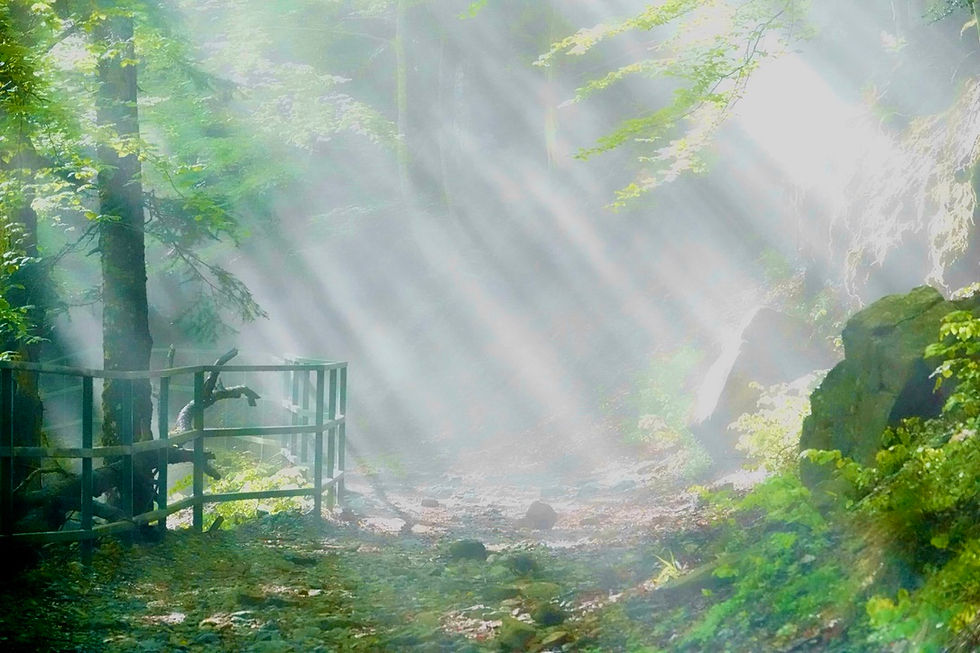
Beech forest close to the outset of the Ordesa hike (Source: own photo)
But, boy, was I happy some five hour later, when I was back at the car that I had not taken the Cazadores route! Maybe it is my advanced age, maybe my fitness isn't quite what it ought to be, maybe it is the flu, which I have been nursing for a few days? Or maybe it is the mountain bike ride I took up the Bujaluero Valley the other day that has given me sore legs? Whatever the reason, I actually found the 20 kilometres conventional route up and down the Ordesa Valley to be quite taxing, so much so that, back at the car, as I was taking the boots off my blistered feet I felt I had dodged a bullet by not going up the Cazadores route!
When you hike in the off-season, as I was doing you drive your car all the way to the car park at the start of the hike (in peak season you must park in Torla and take the bus the last bit). The hike itself is 10 kilometres of relentless and sometimes quite steep uphill. It is the same route back. Along the path, you can take all kinds of little detours to admire the many rapids and waterfalls that give character to the Arazas River as it rushes towards the Ara River, which in turn joins the Cinca River, which becomes the Segre River, which joins Ebro until the water finally pours into the Mediterranean Sea in the Province of Tarragona.

One of the many cascades on the Azaras River (Source: own photo)
Every stage of the hike is spectacular. The first 7 kilometres is easy walking on wide paths that take you through a dark-shaded and moss-covered beech forest, whose foliage, at this time of year, is so verdant as to make you want to turn every leaf into a salad. There is a lot of bird life here and Pyrenean chamois scamper through the undergrowth.

A cute Pyrenean chamois chilling (Source: own photo)
Then, as you reach the tree line there is more light, but the smooth path gives way to a kilometre or so of more challenging rocky terrain as the path runs close and parallel to the river.
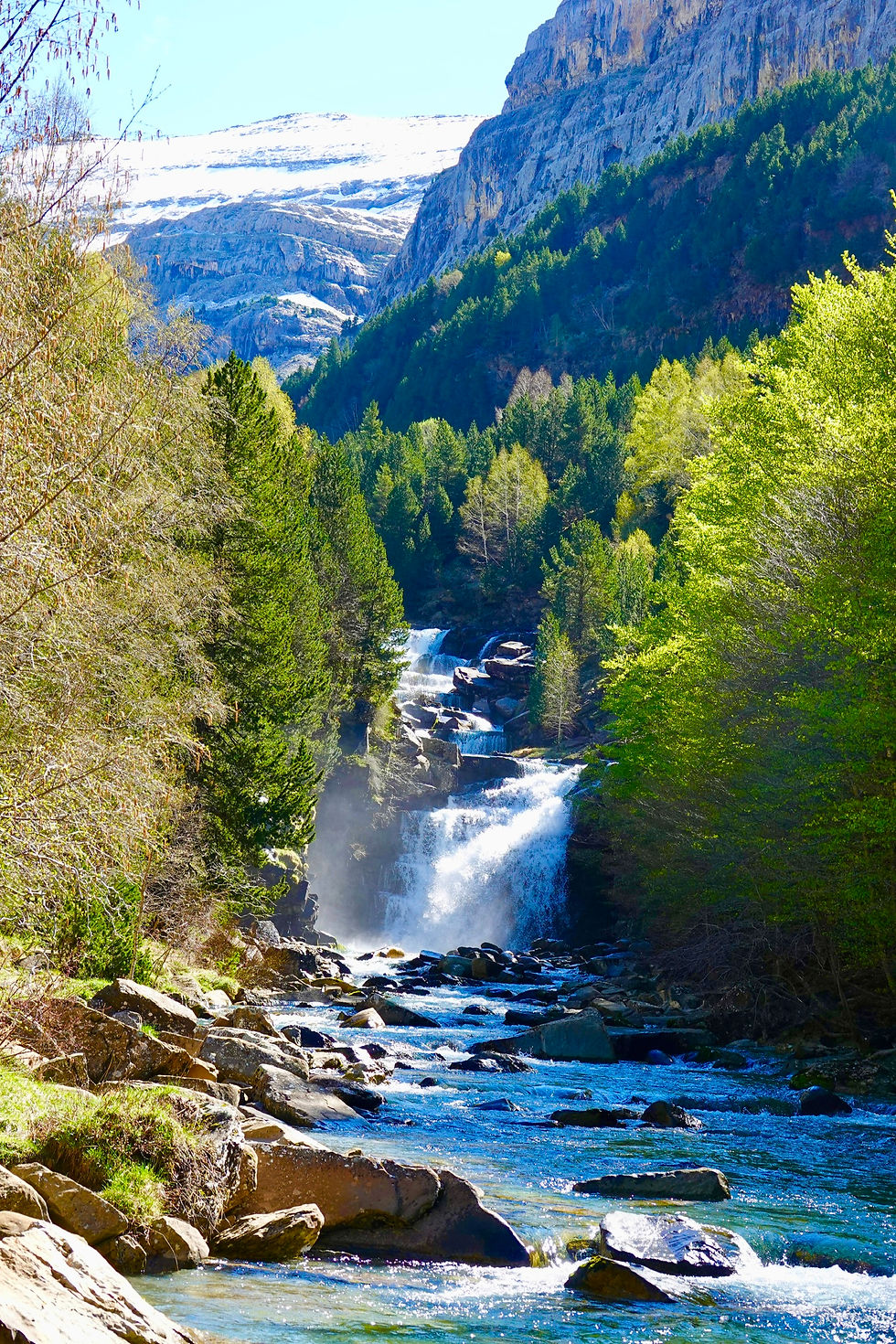
The path takes you right next to the river at this spot (Source: own photo)
Then you emerge onto the level and rather spectacular upper Ordesa Valley floor, which is about 2 kilometres long and several hundred meters wide. At the far end, the snow-clad Monte Perdido rises above proceedings like someone best left alone.

The sight that awaits you exit the trees (Source: own photo)
The grassy valley of this U-shaped geological master-piece is beset on three sides by 1,000 metres high vertical rock faces that give way to scree fields below and low trees and bushes at the transition to grass.

Vertical rocks (Source: own photo)
At the very top of the valley, where you turn around to head back home there is a little waterfall, which pours the meltwater from Monte Perdido into the Azaras. Near the waterfall I found a rock bathed in sunshine. I consumed bread, pâté, humous, and oranges. I washed the food down with cold water.

The waterfall at the turning point of the hike (Source: own photo)
The return was easier than the way up. Downhill obviously helps, although you are also more spent at this point. To my surprise, I found that the last couple of kilometres through the lower beech forest lasted an eternity. Maybe the reason was that I had managed to soak my boots, while crossing a stream on the way down. By the end of the hike, the skin on my wet feet had softened and blistered from friction inside my boots on the steeper bits of the descent. Hike the Ordesa, but always keep you feet dry!
The End


Comments