
Navarre's curiously innocuous cultural divide

Updated: May 12

Basque nationalist illustration on display in the Museo de Navarra in Pamplona (Source: own photo)
The only thing I knew about Pamplona before arriving was the festival of San Fermin during which young men flaunt their reproductive potential to the ladies by getting gored on the horns of stampeding bulls.
After a few days in Pamplona, I was no longer so interested in the bulls. Instead, my curiosity had been roused by the discovery of sharp cultural divisions between Spanish conservatives and Basque nationalists, not just in Pamplona, but in the Kingdom of Navarre as a whole.
Nowadays, the two sides thankfully co-exist peacefully. Indeed, many people in Navarre embrace their dual Spanish-Basque identities. However, this was not always the case. Besides, culturally divided communities have a nasty habit of blowing up. I was therefore constantly comparing what I saw in Navarre with other culturally divided places I have been to, such as Northern Ireland, Rwanda, Bosnia & Herzegovina, Belgium, and Quebec.
As it happens, the Kingdom of Navarre has been a battle ground of cultures for longer than records exist. The region was first populated sometime in the stone age, although no one is sure precisely when. Records began around 1,000 BCE, when the region attracted small Indo-European tribes called the Varduli, Caristii, and Autrigones. They were followed by the Vascones, who, unlike their predecessors, survived both Roman and Germanic tribal invasions to establish themselves as the direct predecessors of today's Basque people.
For as long as they have been here the Basque have been set upon by a long line of rather un-friendly people. First, they struggled against Visigoths, Moors, and the Kingdom of Asturias. Then they fought Spaniards from Castile and Aragon. The French also came knocking a few times and eventually took the northern half of their kingdom away.
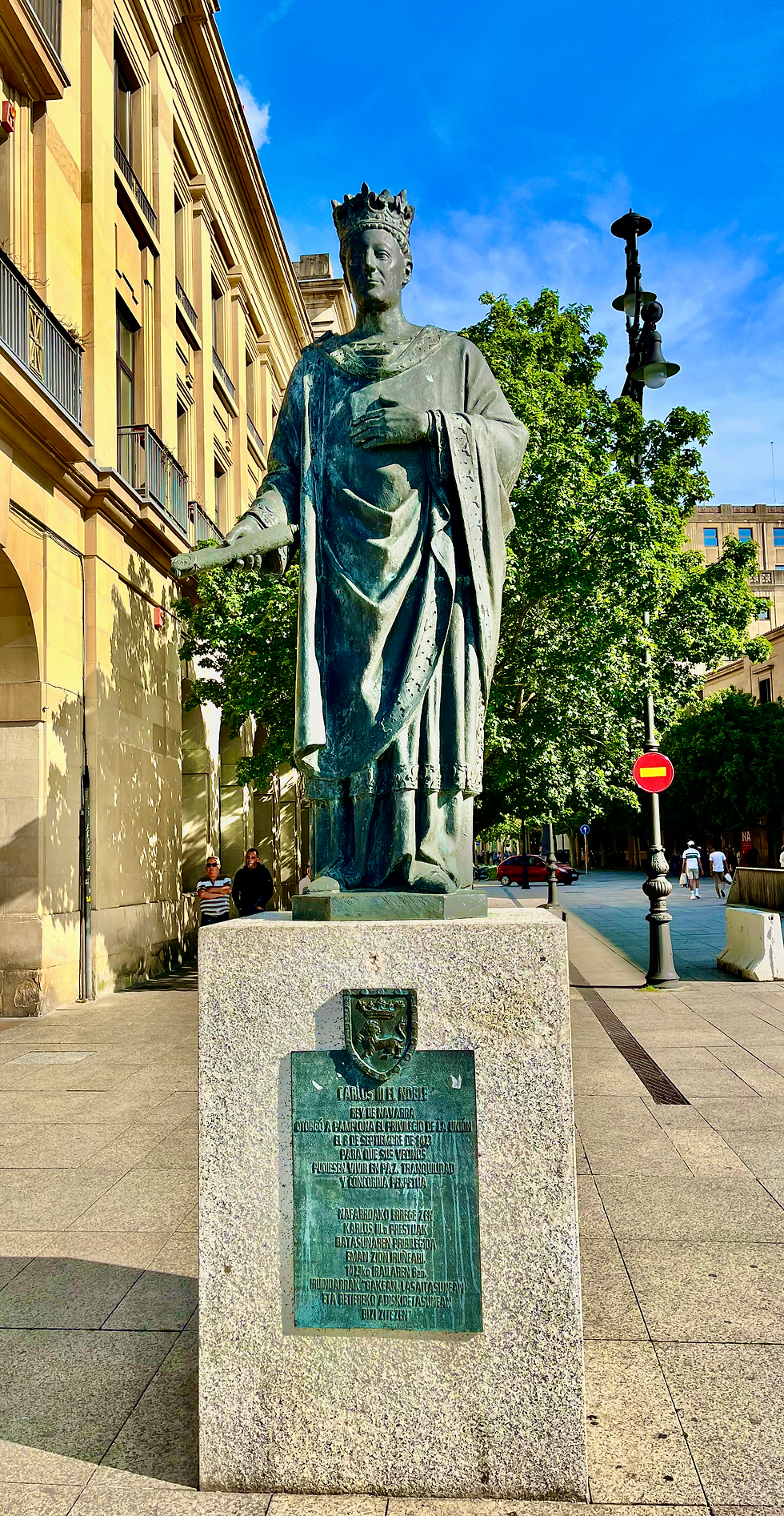
King Sancho III 'The Great' on the main square in Palermo (Source: own photo)
Still, the Basque survived, at times even thrived. Their high point occurred around 1000 CE, when King Sancho III 'The Great' managed for the first and only time to unify all Basque people into a single kingdom. It is in reference to this fine if distant achievement that Navarre still calls itself a kingdom. Navarre does not actually have a king nor has it had one since Ferdinand II of Aragon deposed John III and conquered the region in 1512! Not long after, in 1515, the Cortes of Castile annexed Navarre from Aragon and the last bit of Basque independence fervour was put to the sword at the Battle of Noáin in 1521.
Spain has ruled Navarre ever since.
Spanish rule led to predictable and recurring friction between those who identify as culturally Basque and those who identify as culturally Spanish. These tensions notwithstanding, Navarre managed to maintain a high degree of self-rule even as their attempts at securing independence from Spain were met with violence and repression. Thus, Spain tried hard to eliminate the Basque language in the 1500s, then sharply curtailed Basque legal independence following Navarre's participation on the losing side in the Carlist wars of the 1800s, and Franco banned the use of Basque as an official language during his dictatorship.
Compared to those low points, the last fifty years or so have been relative stable in Navarre. This owes much to the 1978 Spanish Constitution, which granted Navarre special status, including explicit recognition of the region's Basque origins. Navarre was also allowed to maintain its own legal, fiscal, and administrative systems (called "foral'), which did much to mute calls for independence.
Even so, tensions simmer just beneath the surface in Navarre. Two local Basque nationalist political parties with especially strong support in the north demand Navarre unity with the Basque Country to create a greater Basque nation. Nor is this merely a pipe dream; the Spanish Constitution actually provides for a referendum on the matter, if the votes are there.

Sunset over Concha Bay in neighbouring Donostia-San Sebastián (Source: own photo)
Spanish nationalists in Navarre strongly oppose any notion of Basque unification. They are led by the Unión del Pueblo Navarro (UPN), which is a right-wing party with strong links to the Catholic Church. UPN's stronghold is in southern Navarre, where Rioja wine is made. Some of the most reactionary and religious nationalists in all of Spain live here, including the last remaining adherents of Carlism in Spain.
Carlism sets Navarra's Spanish nationalists apart from other Spanish nationalists and it is a genuinely whacky ideology, so it is worth spending a moment on it here. In 1833, King Ferdinand VII of Spain died. His widow, Queen Maria Cristina, assumed the throne on behalf of their daughter, Isabella II, who was two years old at the time. Isabella's right to the throne was enshrined in law, but Ferdinand's brother, Prince ('infante') Carlos, had a strong ambition to become an authoritarian king and was not happy that a little girl was blocking his path to the throne.
His brother had barely been buried, when Carlos assembled a guerrilla army and went to war with Madrid. Carlos received support for his quest by forces from Catalonia, Valencia, Galicia, and the Basque Country, which all opposed central power in Madrid. In Navarre, support for the Carlist cause was strongest of all, to the point of unifying Basques and Spaniards in common cause. For their part, the Basque hoped that a Carlist victory would pave the way to the greater independent Basque nation.
Unfortunately, some seven years later and after 5% of the population of Spain had been killed the Carlists were defeated. Rather than gaining independence, the good people of Navarre were forced to cede major chunks of their independence to Spain.
If you think the Carlists of Navarre are conservative then spare a thought for the Basque. There is perhaps no better illustration of Basque conservatism than the Basque language, which, famously, is unrelated to any other language in the world. The fact that no one really knows where the language comes from suggests that it probably Navarre and the Basque Country itself. But this also implies, of course, that Basque speakers have successfully resisted all outside linguistic influences for centuries! The Basque, it seems, are not exactly among the most open-minded in the world when it comes to culture.

Rebelliousness in the Basque country is no laughing matter (Source: own photo)
Despite the cultural conservatism of both the Spanish and the Basque in Navarre, you are unlikely to bump into self-professed Carlists or Basque nationalists when you visit as a tourist. The locals know the value of tourism money and will not scare you away. You are likely simply to saunter through what is an invisible cultural battleground with complete oblivion.
Yet, if you make a bit more of an effort you soon start to see signs of Navarre's internal divisions. For example, take a look at the map below, which shows the official languages of Navarre's 272 municipalities. The green municipalities in the north are Basque and their official language is Basque. The purple municipalities in the south are Spanish and their official language is Spanish. In between, you have a bunch of mixed municipalities, where Basque and Spanish are both official languages. Navarre is quite evidently an extremely divided community, especially north versus south.

Navarre's municipalities (Source: here)
Here is another example of Navarre's internal divisions: Pamplona is a modestly-sized city of some 215,000 people. It is therefore a bit of an eye-opener, when you discover that the town has no fewer than two large universities. Why two universities? Well, they need them because the two cultures each want their own.
The Public University of Navarre is, as its name suggests, a government-funded institution, which focuses on meeting the needs of the local labour market. This naturally gives it a strong pro-Basque bias. The other university is the University of Navarre and it could not be more different. It was established by none other than the founder of Opus Dei, St. Josemaría Escrivá. Opus Dei is an ultra-conservative, secretive, and cult-like Catholic organisation with 90,000 members worldwide and University of Navarre associates itself strongly with the organisation. It is privately funded, teaches in Spanish, and is obviously deeply conservative.
There are plenty of other duplications of institutions, which all point to the same thing, namely that Navarre's divisions along cultural lines are real and not about to go away. What do such divisions imply for Navarre's future? Ordinarily, one would be inclined to be pessimistic about the region, because culture-based conflicts tend to have long and gory histories - and futures. People caught up in cultural conflicts tend to adopt the twisted intolerances of their culture. Group-think replaces individual thought, mob mentality replaces rationality, and people resist associating with members of other cultures. You are either on one side or the other and woe betide anyone who dares to cross the line!
Classic Romeo and Juliet stuff.
I once had a chat with a Croatian bar-owner in a small town near Dubrovnik. We had barely begun to talk, when he launched into a lengthy tirade about how "his people" had laid waste to "horde of Turks so enormous" that "enough bodies floated past the town to block the river like a dam!" The bar-owner was very proud of the massacre. At first, I was confused, because I couldn't recall any recent wars between Croatia and Turkey. Then it dawned on me that he was talking about the Battle of Sisak of 1593!
Culture-based conflicts are like that. They last forever, because rather than working towards overcoming differences the two sides double down on 'heroic' myths, which only perpetuates mistrust and fuels the politics of division. This is what makes culture-based conflicts so exasperating and depressing. The people caught up in them are losers, authors of their own destruction. They are easily exploited for political purposes, because they blindly swallow the moronic and prejudicial bile sold to them by their own devious politicians. They are always the first and the loudest cheerleaders in wars and in genocides.
I was therefore very positively surprised, when I looked up data on Navarre's economic performance. Frankly, I had expected Navarre to be doing poorer than other Spanish regions in economic terms on account of its deep internal cultural divisions. However, I found the opposite to be true. As the chart below shows, the Basque Country and Navarre rank two and three in Spain in income per capita, lagging behind only the special case of Madrid. Navarre, it seems, has managed to become a great success despite its internal cultural divisions, but how?

Navarre is a success (Source: here)
I do not have the answer, but I do have a hypothesis. From my training as an economist, I know that the most economically successful countries in the world are ones that trade the most with others countries - think Denmark, the Netherlands, Singapore, Switzerland, Hong Kong, South Korea, Taiwan. My favourite illustration of how trade can change a country for the better is China, which exploded onto the global economic stage to become the world's biggest trading nation as soon as Deng Xiaoping opened up to the rest of the world.
Northern Spain, especially the Basque Country and Navarre have always been heavily involved in trade by virtue of their geography. Navarre sits on the most important trade route connecting Spain to the rest of Europe, while the Basque Country has important ports connecting the region to the rest of the world. My thesis is simple; commercial interests have proven strong enough to overcome whatever poison Navarre's politicians have concocted in their bid to place cultural prejudice above profit. May the opportunity cost of culturalism in Navarre continue to prove insurmountable.
The End


Comments