
Golfo de Vizcaya road trip

Updated: May 17

Craggy coastline near La Coruña (Source: own photo)
London gets 550-750mm of rain each year, with some 100 to 150 days receiving some amount of rain in any given year. Those are rookie numbers compared to Spain's Biscay coastline, where cities like San Sebastián regularly receive 1,500-2,000mm of rain per year, with some 220 days a year getting rained on. We have just concluded a road trip through Golfo de Vizcaya. The journey took about a week and we did not have a single dry day. In fact, on some days it rained the whole day without interruption.

Sole - served in the typical style of the region (Source: own photo)
Having said that, this is an extremely beautiful and dramatic region and absolutely worth visiting. This is Spain's richest region. The land is fertile and the sea is rich with fish and other goodies. Snow-clad mountains tumble into the sea and rapid rivers carve deep gorges from high-altitude plains that teem with birds and bears. Waves from unruly Bay of Biscay crash against the craggy coast line, which is lined with tiny fishing villages interspersed between a few larger cities. Here, you get food made simply from the freshest ingredients, usually consisting of slabs of barely cooked beef and fish on the bone, served with boiled potatoes, and a side salad.

A storm moves over San Sebastián (Source: own photo)
Our first port of call was San Sebastián, where we experienced the region's shifting weather patterns for the first time. In the afternoon, I captured a storm moving over the town, but within an hour the sky was giving way to a perfect sunny sunset. Locals make a daily routine of walking along San Sebastián's seafront promenade that lines Bahía de La Concha and it can only be recommended. Still, we found San Sebastián both larger and more touristy than we had expected. Nor did our visit last long enough for us to properly appreciate the famous food scene. In fact, based on the couple of meals we had in San Sebastián we did not think the food quite lived up to the standard we had enjoyed in Pamplona.

San Sebastián sunset (Source: own photo)
Our next destination was Picos de Europa, a mountainous national park with the highest peak, Torre de Cerredo, some 2,650 meters above sea level. The Picos mountains are very close to the coast, which makes for dramatic and somewhat stark landscapes. Unfortunately, it rained almost non-stop during our three days in the area, which limited our ability to explore on foot and mountain bike. Still, if you have a car there is a great circuit around the peaks with a stop for lunch at Potes, where you get the usual meat and potatoes fare. Better still, if you drive down to coastal town of Gijón you can have some seriously delicious fish. Try Restaurante Sidrería El Pedreru, where I had the best fish I have had in many, many years. Looking back at our time in the Picos, the bit we loved the most was the area immediately west Riaño, which is well south of the actual Picos mountains. The lakes and valleys here are simply stunning with abundant bird life.
South of Picos de Europa (Source: own photos)
The final stop on our Vizcaya road trip was La Coruña, but to break up the drive we stopped for a night at the tiny fishing village of Cudillero. It rained, of course, but like in Gijón you get excellent fish here. However, the real highlight for us was the accommodation. We stayed at the Casona de la Paca hotel, which is run by a women-only team. The hotel is housed within a truly classic building and interiors are sumptuous. The service is extremely good as you would expect from a hotel run by serious women.

The exquisite lounge in Casona de la Paca (Source: own photo)
The following morning we drove the remaining 250 kms to La Coruña, passing through valleys with Eucalyptus trees that made me think of the sub-tropical rain forests in Queensland, Australia. La Coruña is special to us, because it was our first port of call after leaving Britain and crossing the Bay of Biscay in our own boat Twende in 2021.
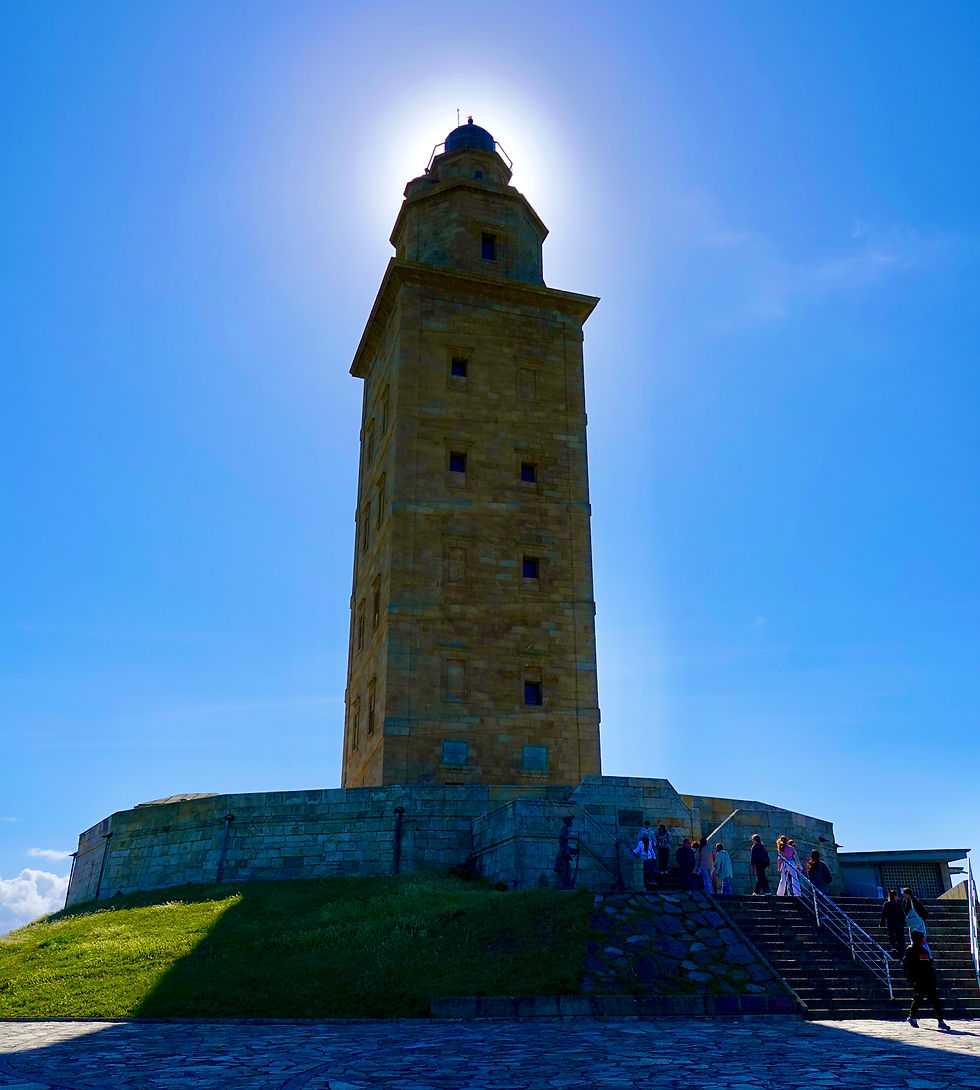
The Hercules Tower in La Coruña (Source: own photo)
Compared to where we came from La Coruña felt large. We were lucky to get an afternoon without rain, so we walked to the marina, where we had first docked Twende some five years ago. We also saw the marina restaurant, where I had enjoyed my very first Pulpo a la Gallega, which is the most iconic of all of Galicia's many special offerings. As we arrived just in time for a typical 3pm Spanish lunch, I was happily able to re-acquaint myself with this absolutely ravishing dish, which did not disappoint.

Pulpo a la Gallega, La Coruña style (Source: own photo)
La Coruna sits at the very north-western corner of Spain, where the sea crashees into the land. The wind blows hard here and unless you get a quiet day you don't see many leisure craft on the water; the sea here is not for kids. But the very same forces that keep us humans in hiding make for forceful displays of nature's power and protects the fauna.
Nature is alive in north-eastern Spain (Source: own photos)
We will be back to Golfo de Vizcaya, but probably during the summer when the weather is a bit better. Next, we are heading south towards Portugal, so watch this space for more updates.
The End


Comments